US Elections and Muslim Americans, Part 2: Where the Money Flows
By Jawed Anwar
Ask anyone what the three biggest issues are in any American election, and the answer is obvious: the economy, the economy, and the economy. Nothing changed in the November 3, 2026, midterm election.
Grocery bills, the cost of filling a gas tank, affordable health care and housing, unemployment, Social Security, and the rising cost of living are the core issues. They reflect what people need and what they worry about.
Issues such as illegal war, hegemonic foreign control, and America's global military involvement only become prominent when they severely hit ordinary people's finances. Every election promises to fix the economy, yet conditions keep getting worse.
Money In
The US economy is a war economy. During the Second World War, the United States supplied arms and aid to Allied countries through programs such as Lend-Lease, totaling roughly $50 billion from 1941 to 1945.¹ This money helped build America's infrastructure: highways, bridges, tunnels, subways, and roads.
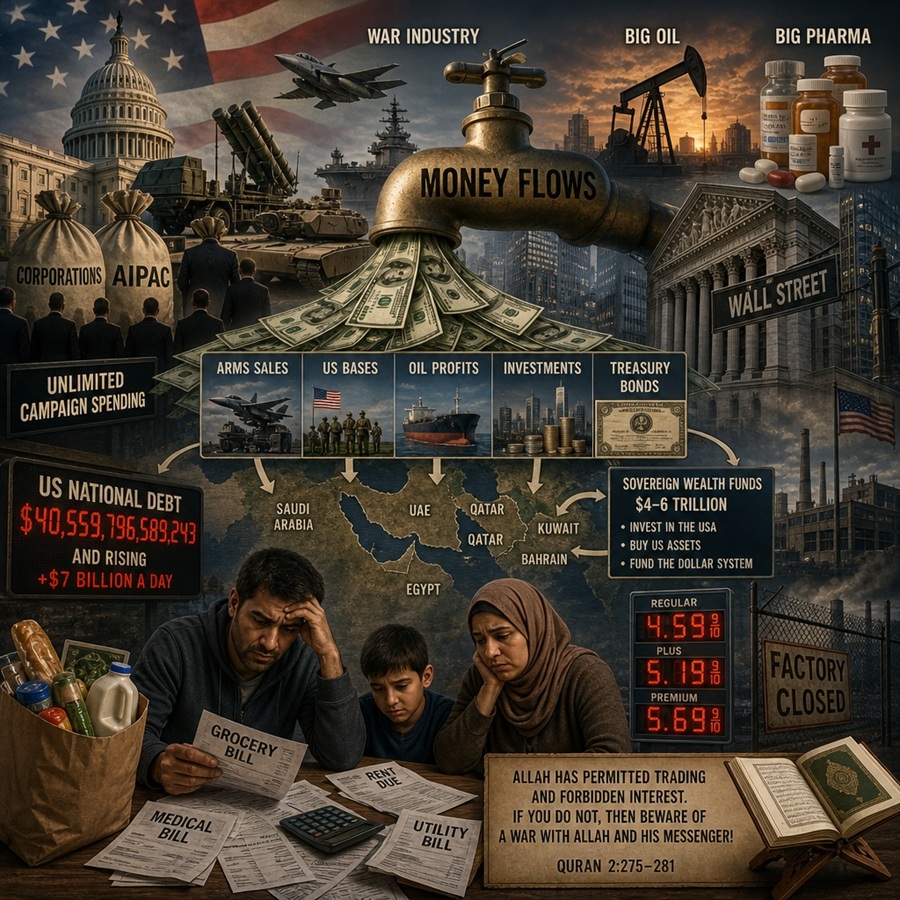
Today, the United States still sells about $118 billion in arms around the world each year (fiscal year 2024 data).² The Gulf states buy a large share:
Saudi Arabia buys $3–10 billion a year, about $150–200 billion in total since 1950. That makes it the largest US arms customer, accounting for about one-third of sales. In May 2025, a new package worth about $142 billion was announced, covering F-15 jets, Patriot and THAAD missile-defense systems, munitions, and training.
Qatar buys about $1–5 billion a year, roughly $40–50 billion in total. Under a new 2025 contract, Qatar is buying about $12 billion in arms, including F-15QA jets, Patriot and NASAMS air-defense systems, MQ-9B drones, and counter-drone systems.
The UAE buys about $1–5 billion a year, roughly $50–70 billion in total.
Egypt buys about $1.3 billion a year, roughly $80 billion in total.
Kuwait buys about $1–3 billion a year, more than $40–50 billion in total.
Bahrain buys less than $1 billion a year, a few billion dollars in total.
Jordan buys about $0.4 billion a year.
Iraq has bought about $20 billion in arms so far.
Gulf countries do not have the ability to use these weapons themselves. Therefore, US bases in those countries control their defense and ensure they are not used against Israel (the real enemy). Gulf nations also share the cost of running these bases. In total, the United States has about 750 bases in roughly 80 countries and territories.
American oil companies in the Gulf earn a large share of the profits through fees and stakes. Most of what these states keep goes back into buying arms and investing in the United States.
The sovereign wealth funds of the Gulf countries manage about $4–6 trillion together, according to IMF and sovereign-wealth-fund tracker estimates. The United States is the biggest single destination for their investments. The UAE's funds hold about $2 trillion. Saudi Arabia's Public Investment Fund (PIF) holds about $0.9–1 trillion, plus more than $400 billion in central bank reserves. Kuwait holds about $0.9–1 trillion, Qatar more than $500 billion, and Oman and Bahrain tens of billions.
Here is where that money sits in America:
US Treasury bonds: According to official Treasury (TIC) data, Saudi Arabia holds about $120–140 billion, the UAE about $90–110 billion, and Kuwait about $40–50 billion, with smaller amounts from Qatar, Oman, and Bahrain. That comes to roughly $250–350 billion combined, and more is likely held through foreign banks and custodians.
US stocks: Hundreds of billions of dollars. The Abu Dhabi Investment Authority (ADIA) and the Kuwait Investment Authority (KIA) hold large US index portfolios. PIF owns stakes in Uber, Lucid, EA, and other companies.
Private equity, tech, and AI: This is a fast-growing area. Examples include the UAE's MGX investing in OpenAI and AI infrastructure, PIF investing in US funds, and the Qatar Investment Authority (QIA) investing in US tech and sports.
Real estate and infrastructure: Tens of billions of dollars. Examples include QIA's stake in Empire State Realty Trust and Mubadala's US holdings.
Dollar bank deposits and reserves: These are large, because most Gulf currencies are pegged to the dollar.
All told, Gulf investments in US assets add up to about $1.5–2.5 trillion. This is an informed estimate, not an official figure.
More has been promised. The UAE has pledged about $1.4 trillion over 10 years. Saudi Arabia has pledged about $600 billion, with talk of raising it to $1 trillion. Qatar has pledged about $1.2 trillion in "economic exchange," including Boeing orders and defense deals. Global SWF estimates that seven major Gulf funds invested about $119–120 billion worldwide in 2025, mostly in the United States.
Under agreements made in 1974, the United States and Saudi Arabia made the US dollar the main currency for pricing and paying for oil around the world. This became known as the "petrodollar" system, and it strengthened the dollar's global role. Because countries need dollars to buy oil, they keep large dollar reserves. Oil-exporting states have also put their surplus earnings back into US Treasury bonds and other American assets. This steady demand lets the United States borrow cheaply and run large deficits, an advantage often called America's "exorbitant privilege."
For a long time, wealth from occupied lands and seized resources—such as Venezuela's oil today—has been flowing into America. The US economy feeds on the labor, the resources, and the lives of millions of people around the world.
Even so, America is deeply in debt. At the close of business on November 9, 2026, the US national debt stood at about $40.56 trillion ($40,559,796,589,243). It is rising by an average of about $7 billion a day.⁶
Where Does All the Money Go?
The deep question is where all this money is going. The economy is huge, so why are ordinary Americans not benefiting? Why can't they afford to live? Why is their economic condition getting worse?
The simple answer is that the money goes to a wealthy few: the giant war industries, the big oil companies, and Big Pharma. Only a little is left over for the people. American democracy is really government of the corporations, by the corporations, and for the corporations.
The corporations and AIPAC (the American Israel Public Affairs Committee) together backed their candidates in both parties' primaries. In the 2026 midterms, AIPAC and its affiliated PACs spent an estimated $84 million to $102 million to support their candidates across both parties, according to campaign-finance monitors.³
In American elections, there is no limit on spending. Candidates and outside groups pour billions into races, and the candidates pay them back once elected. The 2026 Michigan Senate race alone was one of the costliest in history: Republican candidates and allies outspent Democrats on advertising, $143.5 million to $117 million, according to NPR and Quartz.⁴
Manufacturing has moved to China. Tariffs are hurting American industry. The auto industry is in very bad shape, and China's electric vehicles are dominating the world market. Newer fears have also appeared: AI as an existential threat, cybersecurity, and government control in the name of national security. Anthropic CEO Dario Amodei predicted in May 2025 that AI could eliminate roughly half of all entry-level white-collar jobs within the next one to five years.⁵
There may be many reasons for this sharp economic decline. But in the eyes of God, what ruins the economies of states and their people is riba: an interest-based economy and capitalism. Sooner or later, a state built on riba falls.
"Those who consume interest will stand ˹on Judgment Day˺ like those driven to madness by Satan's touch. That is because they say, 'Trade is no different than interest.' But Allah has permitted trading and forbidden interest. Whoever refrains—after having received warning from their Lord—may keep their previous gains, and their case is left to Allah. As for those who persist, it is they who will be the residents of the Fire. They will be there forever.
‘Allah has made interest fruitless and charity fruitful. And Allah does not like any ungrateful evildoer.’
‘Indeed, those who believe, do good, establish Salah (prayer), and pay Zakah (alms-tax) will receive their reward from their Lord, and there will be no fear for them, nor will they grieve.’
‘O believers! Fear Allah, and give up outstanding interest if you are ˹true˺ believers. If you do not, then beware of a war with Allah and His Messenger! But if you repent, you may retain your principal—neither inflicting nor suffering harm.’
‘If it is difficult for someone to repay a debt, postpone it until a time of ease. And if you waive it as an act of charity, it will be better for you, if only you knew.’
‘Be mindful of the Day when you will ˹all˺ be returned to Allah, then every soul will be paid in full for what it has done, and none will be wronged."
(Quran 2:275–281, translation: Dr. Mustafa Khattab, The Clear Quran, for detail commentary on these Ayahs check towards understanding Quran)
Also check Part 1 of the article.
Sources
¹ Office of the Historian, US Department of State, "Lend-Lease and Military Aid to the Allies in the Early Years of World War II."
² US Department of State, "Fiscal Year 2024 U.S. Arms Transfers and Defense Trade," 2025.
³ OpenSecrets, "Crypto, AI and pro-Israel industries were among the biggest spenders—what did they get for their money?" November 2026; Track AIPAC, November 2026; ‘Responsible Statecraft’, "AIPAC dumped more than $55 million into losing midterm candidates," November 2026.
⁴ NPR, October 2026; Quartz, "2026 midterm spending: 7 big-money fights and what it bought," November 2026.
⁵ Fortune, "Anthropic CEO warns AI could eliminate half of all entry-level white-collar jobs," May 28, 2025.
⁶ US Department of the Treasury, "Debt to the Penny," November 9, 2026.
E-Mail: Jawed@SeerahWest.com
Web: as-seerah.com
Facebook: JawedAnwarPage
x: AsSeerah
What’s app Channel (New)
https://whatsapp.com/channel/0029Vb77RLQ0lwgjNnp2Zf2q
Telegram Channel:
Subscribe E-mail:
Recent posts
-
The Mirage of a "Muslim Victory": Soros, RAND, and the Making of America's Progressive Muslim Politicians
09 November 2026 -
US Elections and Muslim Americans – Part 1
05 November 2026 -
Elections, Taghut, and the Duty of Dawah
28 October 2026 -
Carolyn Parrish vs Bonnie Crombie
24 October 2026 -
Voting for Recurring Sin?
14 October 2026 -

City, Town, and School Trustee Elections in Canada: To Whom to Vote, or Not to Vote?
06 October 2026