
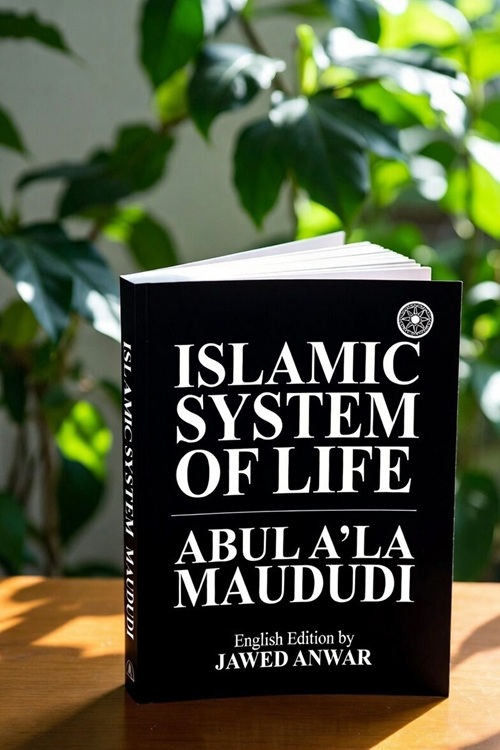
Islamic System of Life - Chapter 6: The Moral Foundations of the Islamic Movement
Syed Abul A'la Maududi (1903–1979)
English Edition: Syed Jawed Anwar
[Why does moral corruption dominate nations and societies today—and how can it be uprooted? Chapter 6 of Islamic System of Life by Abul A'la Maududi delivers a powerful, urgent answer.]
Friends and respected audience!
As you know, the ultimate goal of our struggle is “the revolution of leadership” (inqilab-e-imamat). In other words, the highest destination we seek is to end the leadership and guidance of the wicked and corrupt (fussaq wa fujjar) and establish righteous leadership (imamat-e-salihah). We consider this great effort—working toward this goal—the means of earning Allah’s pleasure in both this world and the Hereafter.
Sadly, today both Muslims and non-Muslims alike remain largely unaware of the true importance of this goal. Muslims often see it merely as a political objective, with little understanding of its deep religious significance. Non-Muslims, due to prejudice or ignorance, fail to recognize the simple truth: the root of humanity’s suffering lies in the leadership of the wicked and corrupt. Humanity’s true well-being depends entirely on righteous people holding the reins of guidance and authority.
The massive corruption we see today—oppression, tyranny, moral decay across societies, the poisoning of civilization, economy, and politics, and the misuse of all earthly resources and scientific discoveries for destruction rather than human welfare—can be traced to one central cause: the leadership of the world lies in the hands of people who have turned away from God, drowned in materialism and immorality. Even though good and upright individuals exist in large numbers, the affairs of the world are not in their hands.
If anyone genuinely desires reform—if they want to replace corruption with righteousness, chaos with peace, immorality with good character, and evil with virtue—then mere preaching of goodness, calls to God-consciousness, or encouragement of moral behavior is not enough. The real duty is this: Gather all the righteous elements within humanity, build collective strength, and work tirelessly to seize the reins of civilization from the corrupt and transfer leadership to the upright.
The Critical Importance of Leadership
Anyone with even a little insight into human affairs cannot fail to see this truth: the ultimate fate of human life—its success or failure—depends on one decisive question: Who holds the reins of authority?
Just as a vehicle always moves in the direction chosen by its driver, and passengers—willing or unwilling—are carried along that path, so too does the vehicle of human civilization travel in the direction set by those who hold its reins.
Obviously, whoever controls the earth’s resources, holds the reins of power, influences people’s lives, shapes ideas and ideologies, controls the tools of education and culture, and directs individual character and social systems will guide humanity—collectively—down the path they desire.
If those in leadership are God-conscious and righteous, then the entire system of life will naturally run on the tracks of faith, goodness, and righteousness. Even the wicked will be compelled toward better behavior. Virtues will flourish, and evils—though they may not disappear—will struggle to grow.
But if leadership lies in the hands of those who have turned away from God and are steeped in immorality, then the entire system will inevitably run on rebellion against God, oppression, and moral corruption. Ideas, knowledge, literature, politics, economics, culture, society, ethics, and law—all will be corrupted collectively. Evils will flourish freely. Virtues will find no soil, no air, no water to sustain them. God’s earth will overflow with injustice and tyranny.
In such a system, walking the path of evil becomes easy, while staying on the path of good becomes difficult—even survival on the straight path turns into a struggle.
Think of a large crowd moving in one direction: a person walking with the flow needs almost no effort. But anyone trying to move against it—even with great force—can barely take a step or two before the crowd pushes them far back.
The same happens in society. When leadership guides humanity down the path of disbelief and immorality, walking that path becomes effortless—people follow it almost automatically. But anyone trying to resist finds themselves pushed back step by step, despite their best efforts.
This is no longer just a theoretical truth—it has become self-evident through observation. Look at your own country over the past hundred years. Ideas, mindsets, ways of thinking, cultural standards, moral values—everything has changed dramatically. What force caused this transformation? The answer is clear: Those who held the reins of power and guidance shaped the entire nation’s ethics, minds, psychology, affairs, and civilization according to their own desires.
Now look at those who resisted this change. How much success did they achieve? How much failure?
Is it not true that even the children of yesterday’s resistance leaders are now swept along by the current of the times? Has not the same corruption reached even their homes?
Is it not true that even from the families of the most sacred religious leaders, people are rising who doubt God’s existence and the possibility of revelation?
After such observation and experience, can anyone still hesitate to accept this reality: In human affairs, the decisive issue is who holds the reins of leadership? This truth has always held the same importance.
The ancient saying—“People follow the religion of their rulers”—is not new. The hadith places responsibility for a nation’s rise or fall on its scholars and rulers, precisely because leadership and authority rest in their hands.
Establishing Righteous Leadership Is the True Goal of Religion
With this understanding, it becomes easy to see the immense importance of this issue in deen (religion, way of life). God’s deen first demands that people become complete servants of the Truth—free from servitude to anyone else. It then requires that God’s law become the law of people’s lives. It demands the eradication of corruption from the earth, the uprooting of evils that bring God’s wrath, and the promotion of every good that pleases Him.
None of these goals can be achieved while the guidance and leadership of humanity remain in the hands of the corrupt and rebellious, with the followers of truth merely living under their tolerance and concessions.
These goals require that all righteous people—who seek God’s pleasure—build collective strength and strive with total dedication to establish a system of truth in which righteous leadership replaces corrupt leadership.
Without this, the core purpose of deen cannot be fulfilled. That is why establishing righteous leadership and a system of truth holds central and purposeful importance in Ad-Deen. Neglecting this means no action—however pious—can bring a person to God’s pleasure.
Reflect for a moment: Why does the Quran and Hadith place such strong emphasis on unity (iltizam-e-jama’at) and obedience (sama’ wa ta’at)? Why does it declare fighting obligatory against anyone who breaks away from the community—even if they profess the testimony of faith and pray and fast?
The reason is clear: Establishing righteous leadership and a system of truth is the true purpose of deen. This purpose depends on collective strength. Anyone who damages that collective strength commits a crime so grave that neither prayer nor the testimony of faith can compensate for it.
Now look at jihad. Why is it given such importance that those who avoid or turn away from it are accused of hypocrisy in the Quran?
Jihad is simply another name for striving to establish the system of truth. The Quran makes jihad the test of true faith. In other words, anyone whose heart truly holds faith cannot accept the dominance of falsehood nor hesitate to sacrifice life and wealth for establishing truth.
Anyone who shows weakness in this matter has questionable faith. How then can any other deed benefit them?
There is not enough time today to explain this fully, but what I have said is sufficient to make one truth clear: From Islam’s perspective, establishing righteous leadership holds central and purposeful importance. Anyone who truly believes in this religion cannot limit their duty to shaping their own life as closely as possible to Islam. The very demand of faith is that they dedicate all their effort to this goal: that the reins of power be taken from disbelievers and corrupt people and placed in the hands of the righteous, so that a system of truth may be established—one that organizes the world according to God’s pleasure and keeps it rightly guided.
Since this goal cannot be achieved without collective effort, the existence of a righteous group becomes essential—a group that itself adheres strictly to the principles of truth and has no other purpose in the world except establishing, maintaining, and properly running the system of truth.
Even if only one believer exists on earth, it is not permissible for him—seeing his isolation and lack of resources—to become content with the dominance of falsehood or seek legal excuses to live a half-hearted religious life under a system of disbelief. The only correct path is to call God’s servants to the way of life He approves.
If some accept his call, he must join them to form a group—a group that devotes all its collective strength to this great purpose I am describing.
Friends! From the little knowledge God has given me of deen, and from my study of the Quran and Hadith, this is what I understand to be the demand of faith. This is what the Book of Allah requires. This is the Sunnah of the prophets. I cannot move from this view unless someone proves—directly from Allah’s Book and the Sunnah of His Messenger (Peace be upon him)—that this is not the demand of deen.
God’s Established Pattern Regarding Leadership
Now that we understand the goal and destination of our struggle, we must understand God’s established pattern (Sunnah of Allah) under which this goal can be achieved.
The universe in which we live operates under a fixed law. Everything follows a set system. No effort succeeds merely through pure intentions or good wishes. Nor can the blessings of saintly souls alone bring results. Success requires fulfilling the conditions that God’s law has set for such efforts.
If you farm, no matter how saintly you are or how much you engage in remembrance of God, no seed will bear fruit unless you follow the natural laws God has set for agriculture.
Similarly, the revolution of righteous leadership you seek will not come through prayers and pure intentions alone. You must understand and fulfill the conditions God has established for leadership to arise, to be granted, or to be taken away.
Though I have mentioned this subject in passing in previous writings and talks, today I wish to explain it in more detail, because without fully understanding it, we cannot clearly see our path of action.
When we analyze human existence, we see two distinct yet intertwined aspects:
- A natural, physical, animal-like existence governed by the same laws that govern all nature and animals. Its functioning depends on physical tools, material resources, and natural conditions—just like other creatures.
- A moral, ethical existence that is uniquely human. This aspect is not subject to physical laws; rather, it governs them to some degree. It uses the physical body as a tool and seeks to bring the external world’s resources under its control. Its driving forces are the moral qualities God has placed within humans, and it is governed by moral laws.
Human Rise and Fall Depend on Ethics
These two aspects work together in human life. Success or failure, rise or fall, depend on both material and moral power. A person cannot succeed without material resources, nor without moral strength.
But a deeper look shows that the decisive factor in human life is moral power, not material power.
There is no doubt that acquiring material resources, using natural tools, and favorable external conditions are necessary for success. As long as we live in this physical world, these remain essential. Yet the core element that truly raises or lowers a person—and has the greatest role in shaping destiny—is moral power.
What makes humans human is not their physical or animal nature, but their moral nature. Humans are distinguished from other creatures not by occupying space, breathing, or reproducing, but by their moral choice and accountability. This makes them not just a species, but God’s vicegerent on earth.
Since the essence of humanity is moral, it must follow that moral qualities hold the decisive position in the rise or fall of human life. Moral laws govern human destiny.
Once we understand this, we see that ethics divides into two main branches:
- Basic human ethics
- Islamic ethics
Basic Human Ethics
Basic human ethics are the qualities on which human moral existence is built. They include all traits necessary for success in this world—whether a person pursues a good purpose or a bad one.
These qualities include strength of will, decisiveness, resolve, courage, perseverance, endurance, high aspiration, readiness to sacrifice, caution, wisdom, understanding of situations, control over emotions and desires, ability to influence and lead others, dignity, generosity, compassion, justice, broad-mindedness, truthfulness, trustworthiness, loyalty, reasonableness, moderation, politeness, cleanliness, and self-discipline.
Any person or group possessing these qualities in abundance will succeed in the world—regardless of whether they are believers or disbelievers, righteous or corrupt, reformers or corrupters. Whoever has these traits will prevail over those who lack them.
A believer or disbeliever, righteous or wicked—anyone can become effective only if they possess these qualities. Without them, no goal—good or bad—can be achieved.
These qualities are like steel: strong in itself, capable of becoming a powerful weapon in the hands of either a bandit or a fighter in God’s cause. The difference lies in the purpose.
The Prophet (peace be upon him) said: “The best among you in the Days of Ignorance (Jahliyah) are the best in Islam.” Those who possessed strong human qualities in the time of ignorance became the most capable men in Islam. Islam simply redirected their abilities to the right path.
Islamic Ethics
Islamic ethics are not separate from basic human ethics—they are their correction and completion.
Islam’s first task is to provide a correct center and purpose for these basic qualities, so they become entirely good. Without this center, these qualities remain neutral power—capable of serving either good or evil.
Like a sword: sharp in itself, it can become an instrument of oppression in a bandit’s hand or a tool of justice in a fighter’s hand. The difference lies in the hand that wields it.
Islam’s call to tawhid (oneness of God) demands that all human effort and striving aim solely at earning God’s pleasure: “And to You we strive and hasten.” And: “You alone we worship, and to You alone we pray and prostrate.” This fundamental reform channels all basic human qualities onto the right path. The power they generate—rather than serving self, family, nation, or country—is devoted purely to raising the banner of truth, using only lawful means.
This transforms neutral power into positive good—a mercy to the world.
Islam’s second task is to strengthen basic human ethics and extend their application to the widest possible limits. For example, patience: Even the most patient person has limits when patience serves worldly purposes. But patience rooted in tawhid and aimed at God has no limit. The world’s combined hardships cannot break it.
A non-Muslim’s patience is limited in scope. He may stand firm under bullets and bombs, yet collapse at the slightest temptation of desire. But Islamic patience spreads across the whole of life. It stands firm against every temptation, fear, doubt, or desire that tries to pull a person from the straight path.
In truth, Islam makes the believer’s entire life a life of patience—holding firmly to right conduct throughout life, no matter the dangers, losses, or difficulties, even if no visible benefit appears in this world. It never chooses wrong, no matter how attractive the promises or hopes.
This is Islamic patience—remaining steadfast on truth and fleeing from falsehood in expectation of the Hereafter’s certain outcomes. It manifests in forms far beyond what appears in limited measure among non-believers.
The same applies to all other basic human qualities. Without a correct foundation, they remain weak and limited. Islam gives them a correct foundation, strengthens them, and extends them fully.
Islam’s third task is to build a magnificent upper level of noble character upon these foundations—the highest level of moral excellence. It purifies the soul from selfishness, materialism, oppression, shamelessness, and unrestraint. It plants God-consciousness, piety, and devotion to truth. It awakens moral responsibility and self-control. It makes a person generous, compassionate, trustworthy, selfless, just, and truthful in every situation—such that only good is expected from him, and evil is feared impossible.
Beyond making a person merely good, Islam—according to the Prophet’s words—makes him “a key to good and a lock against evil.” It entrusts him with the mission of spreading goodness and preventing evil in the world.
With this character comes a natural beauty, attraction, and power of influence. If a group possessing this character organizes and actively pursues its mission, no worldly power can stand against its spread.
Summary of God’s Established Pattern Regarding Leadership
Let me now summarize in a few words the established pattern (Sunnah of Allah) concerning leadership—a pattern that has operated since the beginning of creation and will continue as long as humanity retains its present nature.
If no organized human group exists that is adorned with both Islamic ethics and basic human ethics—and that also effectively uses material resources—then the leadership of the world inevitably passes to a group that may lack Islamic ethics entirely but surpasses others in basic human ethics and mastery of material resources.
God always wants His world to be managed. He entrusts this management to the group that, in the present moment, proves most capable. But if an organized group exists that surpasses the rest of humanity in both Islamic and basic ethics, and does not neglect material resources, it is rationally impossible—and against God’s established pattern—for any other group to remain in leadership.
Such an outcome would contradict nature, God’s Sunnah for humanity, the promises He made to righteous believers in His Book, and His dislike of corruption. God would never allow a righteous group—capable of managing the world according to His pleasure—to exist while leaving leadership in the hands of corrupters.
But remember: This outcome will not happen merely by the existence of such a group. No sudden miracle will remove corrupt leaders and place the righteous in power. This group must struggle against the forces of disbelief and immorality in every field of life. It must sacrifice everything on the path of establishing truth and prove its love of truth and its capability through action.
This condition applied even to prophets—they were not exempt. How then can anyone today expect exemption?
The Difference in Power Between Basic Ethics and Islamic Ethics
From deep study of the Quran and history, I have understood God’s established pattern regarding the balance between material and moral power:
Where moral power rests only on basic human ethics, material resources carry great importance. A group with vastly superior material power can prevail even with relatively little moral power.
But where moral power combines both basic human ethics and full Islamic ethics, even extreme shortages in material resources are overcome. The power of Islamic ethics compensates for 75% or even 95% of material deficiency.
In the Prophet’s era, Islamic ethics of the highest level (as seen in him and his Companions) could succeed with only 5% of the material power of opponents.
This is the reality indicated in the verse: “If there are twenty patient ones among you, they will overcome two hundred.” (Al-Anfal 8:65) This is not wishful thinking or talk of miracles. It is a natural reality operating under cause-and-effect in this world of means. It can happen anytime the causes are present.
Let me briefly explain how Islamic ethics (which include basic ethics) compensate for 75% or even 95% of material deficiency.
Look at the international situation before you. The great war that began five and a half years ago (referring World War 1) has ended with Germany’s defeat, and Japan’s defeat appears imminent.
In basic human ethics, both sides were roughly equal—perhaps Germany and Japan showed greater strength in some respects. In natural sciences and their application, both sides were also equal—Germany even had superiority in some areas.
Yet one side possessed far greater material resources—many times more than both opponents combined. Its geographical position was better, and historical circumstances gave it decisive advantages.
For this reason, it achieved victory.
Today, no nation with fewer numbers and fewer resources can realistically hope to rise against larger, better-equipped nations—even if it surpasses them in basic ethics and natural sciences. Such a nation will face one of two outcomes:
- If it is openly nationalist, seeking to dominate others, it can succeed only by surpassing them in material power. All targeted nations will resist with intense hatred and, refusing to yield until crushed.
- If it supports some universal principles while hiding nationalism, it might hope to win hearts through its call. But winning hearts requires genuine goodwill, sincerity, truthfulness, selflessness, generosity, compassion, and justice—proven through every test of war and peace, victory and defeat, friendship and enmity. This belongs to the highest level of noble character, far beyond basic ethics.
This is why nations relying only on basic ethics and material power—whether openly nationalist or pretending to universal ideals—ultimately reveal pure self-interest, group interest, or national selfishness (as clearly seen today in the foreign policies of America, Britain, and Russia). In such struggles, every nation becomes a solid rock against the other, devoting all moral and material power to resistance, refusing passage unless crushed by superior material force.
Now imagine in this same environment a group (perhaps starting within one nation, but not as a “nation,” rather as a “movement”) that is completely free from personal, class, or national selfishness. Its only aim is humanity’s welfare through certain principles, and establishing a system of life on those principles.
In the society it builds, national, racial, class, and tribal distinctions vanish. All humans can join with equal rights and status. Leadership belongs to whoever excels in following those principles—regardless of race, nation, or origin. Even a conquered people can become leaders if they accept faith and prove righteousness—the conquerors will place all fruits of their sacrifices at their feet and willingly follow them.
When this group rises with its call, those who refuse to allow its principles to prevail resist it. Conflict begins.
But as the struggle intensifies, this group demonstrates ever-higher moral superiority over its opponents. Through its actions, it proves its sole concern is humanity’s welfare. Its enmity is only toward misguidance—not toward people’s persons or nations. If they abandon misguidance, it can embrace even its bloodthirsty enemies.
It has no greed for others’ wealth, trade, or industry—only for their moral and spiritual welfare. If achieved, their wealth remains blessed for them.
It never resorts to lies, deceit, or treachery—even in the hardest tests. It answers crookedness with straight measures. It never turns to oppression in revenge. Even in war’s harshest moments, it never abandons the principles it calls others to follow. It upholds truth, loyalty, and good conduct in every situation.
When its God-fearing, righteous, devoted, kind, and noble fighters face the adulterous, drunken, gambling, hard-hearted armies of opponents, their humanity visibly surpasses their opponents’ brutality. Captured enemies arriving in their midst see an atmosphere of goodness, dignity, and moral purity—their own polluted souls begin to cleanse.
When they conquer a territory, the conquered experience forgiveness instead of revenge, justice instead of oppression, compassion instead of cruelty, humility instead of arrogance, calls to goodness instead of insults, truthful invitation instead of false propaganda. They see conquerors who do not violate women’s honor, plunder wealth, crush economic power, or humiliate national pride—but instead ensure no one’s chastity is harmed, no property damaged, no rights denied, no immorality cultivated, and no collective oppression remains.
Contrast this with the opponent’s arrival—where entire populations cry out from their cruelty and excess.
Now judge for yourself: In such a conflict, how great a difference exists compared to nationalist wars!
Clearly, in such a struggle, superior humanity will ultimately defeat inferior material power—even with far fewer resources. Weapons of noble character will outrange cannons and rifles. Enemies will become friends—first hearts, then bodies. Populations will surrender without fighting. Once this righteous group starts—even with a small number and few resources—soldiers, experts, weapons, supplies, and war materials will flow to it from the enemy camp itself.
What I am saying is not mere conjecture. The historical example of the Prophet (peace be upon him) and the Rightly Guided Khulafa (Caliphs) (may Allah be pleased with them) stands before you. This has happened before—and it can happen again—if anyone has the courage to try.
Respected audience!
I hope this address has made clear to you that the real source of power is moral power. If an organized group exists that combines basic human ethics with full Islamic ethics—and also makes effective use of material resources—it is rationally impossible and against nature for any other group to retain world leadership.
I also hope you now clearly understand the root cause of Muslims’ current decline: Those who lack material resources, basic ethics, and—collectively—Islamic ethics cannot remain in leadership. Allah’s unchanging, impartial pattern gives preference to disbelievers who—though lacking Islamic ethics—surpass them in basic ethics and material mastery, proving themselves more capable of managing the world.
If you have any complaint about this, it should not be against God’s pattern—but against yourselves. The remedy is to remove the deficiencies that have turned you from leaders into followers, from pioneers into laggards.
Now it is necessary that I clearly present before you the foundations of Islamic ethics—for I know that Muslims’ understanding of this matter is badly confused. Due to this confusion, few truly know what Islamic ethics really are, or in what order and progression the human soul should be trained and perfected.
The Four Levels of Islamic Ethics
What we call Islamic ethics consists—according to the Quran and Hadith—of four levels:
- Iman (Faith)
- Islam (Submission)
- Taqwa (God-consciousness)
- Ihsan (Excellence in worship and character)
These four levels follow a natural progression: each higher level is born from the one below and stands upon it. No higher level can be built until the lower one is firm and complete.
In this entire structure, Iman (Faith) is the foundation. Upon it stands the level of Islam (Submission). Above that rises God-consciousness, and at the very top is excellence.
Without faith, there is no possibility of submission, Taqwa (God-consciousness), or Ihsan (Excellence in worship and character). If Iman (Faith) is weak, no higher level can bear weight. If Iman is limited, Islam, Taqwa, and Ihsan remain limited to the same narrow scope.
Unless Iman is fully correct, firm, and expansive, no wise person who understands deen would begin building Taqwa or Ihsan. Similarly, Islam must be corrected, strengthened, and expanded before Taqwa, and before Ihsan.
Yet we often see people ignoring this natural and logical order. They speak of Taqwa and Ihsan without first perfecting Iman and Islam. Even worse, many have a severely limited understanding of Iman and Islam.
This has led to the belief that simply adopting certain outward forms—beard length, clothing style, prayer rituals—is sufficient for Taqwa, and adding extra prayers, remembrances, litanies, and spiritual exercises achieves Ihsan.
Yet often, alongside this supposed “Taqwa” and “Ihsan,” clear signs appear showing that Iman itself is not yet correct or firm.
As long as these mistakes persist, we cannot succeed in completing the curriculum of Islamic ethics. Therefore, we must gain a full understanding of Iman, Islam, Taqwa and Ihsan—and clearly grasp their natural order.
1. Iman (Faith)
Let us begin with Iman—the foundation of Islamic life.
Everyone knows that Iman means affirming Allah’s oneness and the prophethood of Muhammad (peace be upon him). When someone makes this affirmation, they fulfill the legal condition for entering the circle of Islam and deserve to be treated as a Muslim.
But is this simple affirmation—sufficient for legal purposes—also enough to build the entire three-story structure of Islamic life?
Many think so. That is why they begin building Islam, Taqwa, and Ihsan upon this minimal affirmation—often resulting in structures no more solid than castles in the air.
In reality, for a complete Islamic life to be built, Iman must be fully expansive in its details and deeply firm in its depth. Any branch of Iman left incomplete will leave that part of Islamic life unbuilt. Any weakness in its depth will make the entire structure shaky at that point.
For example, consider Iman in Allah—the first foundation of deen (religion). As Iman expands into details, people’s understandings vary widely:
- Some stop at: “God exists, created the world, and is One.”
- Others extend only to: “God is our Lord, deserving worship.”
- Some broaden further: God is All-Knowing, All-Hearing, All-Seeing, Answerer of prayers, Judge of needs—and has no partner in worship or in His attributes, rights, and authority. The final authority in religious matters is His Book alone.
Obviously, different understandings produce different lives. The narrower the conception of Iman in God, the narrower the Islamic color in practical life and ethics. Even at its broadest in common religious views, faith in God may allow loyalty to rebels against God alongside loyalty to Him—or blending systems of disbelief with Islam.
Similarly, the depth of Iman in God varies. Some affirm God’s existence yet refuse to sacrifice even minor things for Him. Some hold certain things dearer than God, but other things dearer still. Some sacrifice life and wealth, yet cannot sacrifice their desires, opinions, or reputation.
Islamic life’s stability depends exactly on this measure. Where Iman remains weak in depth, Islamic ethics fail at that point.
A complete Islamic life can be built only on an affirmation of God’s oneness that extends over the whole of individual and collective life—one that recognizes God as the sole Owner, Lord, Worshipped, and Authority over oneself and the entire world. One that accepts His guidance as the only source, fully convinced that any deviation from God’s obedience, any independence from His guidance, or any association with His Being, attributes, rights, or authority—in any form or degree—is pure misguidance.
Further, this structure gains stability only when a person consciously and deliberately decides: “I and everything I have belong to God and exist for God alone.” One eliminates personal likes and dislikes, aligning thoughts, opinions, desires, emotions, and ways of thinking with the knowledge God has given in His Book. One cuts off all loyalties that do not submit to God’s loyalty—or that stand in opposition to it. One places love of God highest in the heart and removes every idol demanding greater love than God.
This is the true level of faith (Iman) in God. You can see for yourself: Where Iman lacks this breadth, depth, and firmness, what possibility exists for Taqwa (God-consciousness) or Ihsan (excellence)? Can deficiencies in Iman be compensated by long beards, specific clothing styles, rosary counting, or extra night prayers?
The same applies to all other aspects of Iman. Iman in prophethood is incomplete until the soul accepts the Prophet (peace be upon him) as guide in every matter of life and rejects all guidance contrary to or independent of his. Iman in the Book remains imperfect while any part of life accepts principles or laws outside God’s revealed guidance. Iman in the Hereafter is incomplete while the soul does not prefer the Hereafter over the world and does not reject worldly values in favor of eternal ones—while the awareness of accountability in the Hereafter does not prick the conscience at every step.
If these foundations remain incomplete, on what can the grand structure of Islamic life be built?
When people thought they could build Islamic ethics without first perfecting Iman (Faith) and Islam (Submission), the result was that judges ruling against God’s Book, lawyers arguing on non-Shariah laws, workers managing life under systems of disbelief, leaders fighting to establish civilization on non-Islamic principles—all claimed high ranks of Taqwa (God-consciousness) and Ihsan (excellence) simply by adopting certain outward forms and extra prayers.
2. Islam (Submission)
When the foundations of Iman become complete and deep, the level of Islam begins to rise upon them.
Islam is actually the practical expression of Iman. Iman and Islam relate like seed and tree. The seed manifests itself in the form of the tree. Examining the tree reveals what was in the seed.
You cannot imagine a seed existing yet producing no tree. The same applies to Iman and Islam. Where Iman exists, it necessarily appears in a person’s practical life—in ethics, conduct, relationships, alliances, enmities, direction of effort, mindset, use of time, powers, and abilities—in every aspect of life.
Wherever Islam (submission to God) is absent—wherever non-submission appears—you can be certain that faith is either missing in that area or so weak and lifeless that it produces no fruit.
From my understanding of the Quran and Hadith, it is impossible to have Iman in the heart yet lack Islam in action. (At this point someone asked: “Do you consider Iman and action the same thing, or is there a difference?” I replied:) Set aside for a moment the debates of jurists and theologians. Look directly at the Quran. It clearly shows that Iman (belief) and practice are inseparable. God repeatedly mentions Iman and righteous action together. All the promises He makes are for those who believe in their hearts and submit in their actions.
When the Quran exposes hypocrites, it uses the flaws in their actions to prove defects in their faith. Practical submission is the true sign of real faith.
Legally, declaring someone a disbeliever and cutting ties with the community is a separate matter requiring extreme caution. But I am speaking here not of legal faith and submission, but of the faith and submission valid in God’s sight—upon which eternal outcomes depend.
In reality—if you look at the matter truthfully—wherever practical surrender and submission to God are lacking, wherever personal desires differ from God’s pleasure, wherever loyalty to others stands alongside loyalty to God, wherever effort focuses on goals other than establishing Allah’s deen—there faith is defective. Obviously, no Taqwa or Ihsan can be built on defective Iman.
No matter how much someone imitates the outward forms of the pious or copies certain acts of the excellent, outward shapes without inner reality are like a beautifully preserved corpse—perfect in appearance but lifeless. Deceived by its fine appearance, you may place hopes in it—but real-world experience will quickly prove it useless. A living, even rough-looking person is far more effective than a lifeless, beautiful corpse.
You may deceive yourself with outward appearances, but you cannot affect the real world—or gain any weight in God’s scale.
If you seek true Taqwa (God-consciousness) and Ihsan (excellence)—not mere appearance—that can establish deen in the world and weigh heavy in the Hereafter, then understand clearly: These higher levels can never rise unless the foundation of Iman (faith) is strong and its strength is proven through practical submission (Islam)—actual obedience and surrender.
3. Taqwa (God-consciousness)
Before speaking of Taqwa, let us understand what it really is.
Taqwa is not a specific appearance, dress, or way of socializing. It is a state of the soul born from the fear of Allah and a deep sense of responsibility. It manifests in every aspect of life.
True Taqwa means: In the heart, there is fear of Allah, awareness of servitude, a sense of accountability before Him, and a living realization that this world is a testing ground. Allah has sent us here for a limited time to be tested in how we use the powers, abilities, and resources He has given—how we deal with people He has placed in our lives through His decree.
When this awareness and sense awaken in a person, their conscience becomes alive. Their deeni/religious sense sharpens. Anything contrary to God’s pleasure begins to prick them. Their nature rejects everything God dislikes. They begin examining themselves: What tendencies and inclinations are growing within me? They begin holding themselves accountable: How am I spending my time, powers, and abilities? They naturally avoid even doubtful matters—let alone clear prohibitions. Their sense of duty compels them to fulfill all commands with full obedience.
Their fear of God makes their steps tremble whenever there is risk of crossing His limits. Protecting God’s rights and people’s rights becomes their constant habit. Even the thought of possibly doing something against truth makes their conscience tremble.
This state does not appear in just one form or limited area. It shows throughout a person’s entire way of thinking and all of life’s actions. Its effect creates a uniform, consistent character—pure and clean in every dimension.
In contrast, where Taqwa is merely an outward label—adopting certain forms and following specific methods without inner reality—the person carefully avoids only the impurities listed in their memorized rules, yet remains stained with countless worse evils not on their list.
The difference between true and artificial Taqwa is like this: One person has a natural sense of purity and love of cleanliness. They hate dirt in any form and naturally seek cleanliness—whether or not they have a complete list. Another person lacks this inner sense but carries a copied list of impurities and purities. They avoid only what is on their list—but live immersed in far worse filth simply because it was not listed.
This difference is not theoretical. You can see it with your own eyes in the lives of many who are famous for their piety. On one hand, they are extremely careful about details of religious law—beard length, ankle coverage, prayer rituals. Deviating from their school’s minor rules is treated as sin. Yet on the other hand, their neglect of religion’s core principles and universals has reached such a level that they have based Muslim life on concessions and political expediency.
They have created countless escape routes from striving to establish deen of Allah. Their entire effort goes into designing “Islamic life” under non-Islamic dominance—convincing Muslims that they can fulfill religion’s demands while living under and even serving a system of disbelief.
Even more regrettable: When someone presents deen/religion’s true demands and calls for striving to establish it, they not only ignore it—they invent excuses, justifications, and tricks to avoid it themselves and discourage Muslims from it. Yet their supposed piety remains unquestioned.
The same difference between true and artificial Taqwa appears in countless forms. But you can perceive it only when you clearly understand the true concept of Taqwa.
I am not denying the importance of outward manners, dress, and conduct as prescribed in the Sunnah—God forbid. I fully believe a believer should follow every command of God and His Messenger. Deen seeks to correct both inner and outer life.
What I want you to understand is this: The essence is inner reality, not outward appearance.
First, focus on planting and nurturing the seed of reality in the inner self. Then shape the outward according to that reality. Your greatest and first concern should be developing the qualities most valuable in God’s sight—those the prophets were sent to cultivate.
Outward beauty will naturally follow from inner reality. Any remaining deficiencies can be addressed in later stages.
4. Ihsan (Excellence)
Now consider Ihsan—the highest level of Islam.
Ihsan is deep love and attachment to God, His Messenger, and His deen—sincere loyalty and complete self-sacrifice that makes a person “annihilated in Islam” (fana fi al-Islam). The basic concept of Taqwa is fear of God—motivating avoidance of His displeasure. The basic concept of excellence is love of God—motivating the pursuit of His pleasure.
Think of government employees. Some perform all assigned duties with perfect diligence and honesty—never violating rules or harming the state. These are the pious (muttaqi) employees.
Then there are the truly loyal and devoted—those who love the state with heart and soul. They do not limit themselves to assigned duties. Their hearts constantly seek ways to advance the state’s interests. They go beyond requirements. If the state faces danger, they are ready to sacrifice life, wealth, and family. A violation of law pains them. Signs of rebellion make them restless—they spare no effort to suppress it. Deliberately harming the state is unthinkable. Even seeing its interests harmed is unbearable.
Their deepest desire is that their state’s flag flies supreme over the world—no corner left unconquered.
The first group is the state’s pious servants (muttaqi). The second is its excellent servants (muhsin). While the pious receive promotions and good records, the highest honors go only to the excellent.
Apply this example to Islam’s muttaqi and muhsin. The pious are valuable and trustworthy—but Islam’s real power lies with the excellent.
The real work Islam seeks in the world can only be accomplished by this group.
Once you understand the reality of Ihsan (excellence), judge for yourself: Those who see God’s deen clearly overpowered by disbelief—God’s limits not just violated but abolished—God’s law formally repealed—God’s earth ruled by rebels against Him—corruption and moral decay spreading through society—and Muslims rapidly falling into disbelief and immorality—and yet feel no restlessness, no urge to change this state, but instead reassure themselves and other Muslims that living under non-Islamic dominance (even serving it) while maintaining limited religious practice fulfills religion’s demands—how can they be counted among the excellent?
With this immense crime, how can outward acts—extra prayers, strict adherence to minor details, spiritual exercises—earn them the rank of excellence (ihsan)?
If a person has true faith, fulfills duties, possesses good character, upholds God’s limits, and gives God His due loyalty and sacrifice—but lacks outward refinement and polish—his status may be that of a good but rough servant. He may not reach the highest ranks due to poor manners—but do you think God will nullify his loyalty and throw him into Hell simply because he was not refined?
Conversely, suppose another person perfectly follows religious fashion and etiquette—but lacks loyalty, duty, and zeal for faith. Do you think God will value his outward perfection while ignoring his inner defects?
This is not a complex legal issue requiring books. Simple reason tells any person what truly holds value in God’s sight.
Even worldly governments distinguish between true worth and superficial qualities. The English government before you values appearance and manners highly. Yet they know what truly matters.
A military officer who raises their flag with heart, soul, and total effort—who never hesitates to sacrifice in decisive moments—may be rough, unshaven, poorly dressed, lacking social graces—but they will place him at the highest ranks.
But someone who embodies perfect etiquette and society’s norms—yet lacks loyalty and sacrifices self-interest in critical moments—may face court-martial, let alone promotion.
If imperfect human governments make such distinctions, what do you imagine of your Lord? Will He be deceived by outward polish and stamps of approval—valuing appearance over reality?
I am not denying the importance of outward refinement or the prescribed manners of dress, conduct, eating, and socializing in the Sunnah—God forbid. A believer must follow every command of God and His Messenger. Religion/deen corrects both inner and outer.
What I want you to understand is this: The essence is inner reality, not outward appearance.
First plant and nurture the seed of inner reality. Then shape the outward accordingly. Your primary concern should be cultivating the qualities most valuable to God—those the prophets (peace be upon them) were sent to develop.
Outward beauty naturally follows inner reality. Any remaining deficiencies can be addressed later.
I pray that God grants all of us true understanding of deen and the ability to fulfill all its demands according to that understanding. (Ameen)
Recent posts
-
Islamic System of Life - Chapter 9: Bearing Witness to the Truth
09 February 2026 -
Islamic System of Life - Chapter 8: Jihad in the Path of God
08 February 2026 -
Islamic System of Life - Chapter 7: Construction and Destruction
08 February 2026 -
Islamic System of Life - Chapter 5: Islam’s Ethical Perspective
04 February 2026 -
Islamic System of Life - Chapter 4: The True Deen (Way of Life)
26 January 2026 -
Islamic System of Life - Chapter 3: Islam and Jahiliyyah (Ignorance)
25 January 2026