
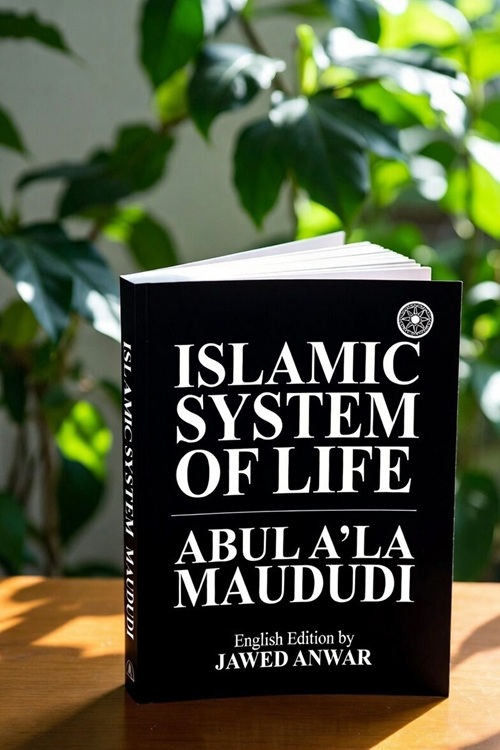
Islamic System of Life - Chapter 1: Rational Proofs for Tawhid, Prophethood, and Life after Death
Syed Abul A'la Maududi (1903–1979)
English Edition: Syed Jawed Anwar
Publisher’s Note
For many years, there has been a growing need for a concise yet comprehensive book that sheds light on all aspects of the Islamic way of life—one that speaks directly to the modern mind, addresses common doubts, and provides intellectual and spiritual satisfaction to the average reader.
This book brings together some of Maulana Maududi’s most influential articles and lectures that explore the foundational principles of the Islamic System of Life (Islami Nizam-e-Zindagi). These writings form the intellectual bedrock for understanding Islam as a complete, practical system encompassing faith, morality, society, and governance.
The collection covers the following key topics:
- Rational Proofs for Tawhid, Prophethood, and Life after Death
- The Path to Peace and Security (Salamti)
- Islam and Ignorance (Jahiliyyah)
- The True Deen (Way of Life)
- Islam’s Ethical Perspective
- The Moral Foundations of the Islamic Movement
- Construction and Destruction
- Jihad in the Path of Allah
- Bearing Witness to the Truth
- Muslims: Past, Present, and Future
- Islam’s System of Life
Readers will find powerful, rational arguments that appeal to contemporary thinking—arguments that affirm the existence and oneness of God, the truth of prophethood, and the reality of the Hereafter in ways that resonate deeply with the heart and mind. Islam is presented convincingly as the true religion (Deen-e-Haq), with clear explanations of its philosophy of ethics, its view of history, and its concept of jihad. In addition, the book offers a clear, concise overview of the comprehensive Islamic system of life that the faith seeks to establish, giving readers a complete picture at a glance.
We hope this collection serves as a valuable resource for anyone seeking to understand the Islamic way of life, appreciate its depth, and feel drawn toward it. The name of Maulana Syed Abul A'la Maududi—renowned thinker, and scholar of Islam—alone is a guarantee of the book’s authenticity, depth, and reliability.
This English edition has been carefully prepared with North American readers in mind: the language is clear and modern (using American English), the structure follows contemporary reading standards, and the content remains faithful to the original Urdu while remaining accessible to high school students, university learners, and general audiences.
May it inspire reflection, strengthen faith, and contribute to building a just and balanced state and society rooted in divine guidance.
Syed Jawed Anwar
Toronto, Canada
(January 2026)
[Discover the timeless wisdom of one of Islam's most influential thinkers in this accessible English edition. Islamic System of Life by Maulana Syed Abul A'la Maududi presents a clear, rational exploration of Islam as a complete way of living—covering faith, ethics, society, and more. Start with Chapter 1, a powerful logical defense of the core beliefs: Tawhid (Oneness of God), Prophethood, and Life after Death. Perfect for seekers, students, and anyone curious about Islam's intellectual depth in today's world.]
Reason's Verdict
In big cities, we see hundreds of factories running on electricity. Trains and streetcars speed along. At dusk, thousands of bulbs suddenly light up. In summer, fans whirl in every home. None of this surprises us anymore, and we never argue about what makes these things glow or move.
Why? Because we know the power plant behind it all. We know the people who work there. We know the engineer in charge, who understands how to generate electricity using machines and turbines. We have seen the entire chain: the cause produces the visible effects—light in bulbs, motion in fans, movement in trains and factories.
Now imagine the same scene—but the wires delivering the power are hidden. The power plant is out of sight. We know nothing about the workers or the engineer running everything with skill and authority. Would our minds still feel at ease seeing those lights and motions? Would we agree so easily on the causes?
Obviously not. When effects appear but causes stay concealed, wonder mixes with unease. Minds start searching for explanations. People guess and argue. Different theories emerge.
Take that thought experiment further. Suppose this hidden setup is the actual reality. Thousands of lights glow, millions of fans spin, vehicles race, factories hum—but no one can trace the power source. People stare in amazement. Everyone races their mind to explain it.
One group says: “These things light up and move on their own. Nothing external causes it.”
Another says: “It’s just the way their materials are combined. That combination naturally produces light and motion.”
A third claims: “Invisible Gods or spirits are behind it—one lights the bulbs, another runs the streetcars, someone else turns the fans, and yet another powers the factories.”
Some people eventually give up: “Our minds can’t crack this mystery. We only know what we see and feel. Anything beyond that—we can neither confirm nor deny.”
These groups argue fiercely, but all they have are guesses, assumptions, and opinions—no solid evidence.
Then one person steps forward: “Friends, I have a source of knowledge you don’t. Through it, I’ve learned that all these lights, fans, vehicles, and factories connect to hidden wires carrying power from a huge plant. Mighty turbines there are run by many workers under one supreme engineer. His knowledge and authority created and oversee the whole system.”
He proclaims this confidently. People reject him. Groups unite against him. They call him crazy, beat him, torture him, drive him out. Yet despite every spiritual and physical hardship, he never wavers. No fear or bribe makes him change a single word. Everything about him radiates complete certainty in his claim.
Then another person arrives, saying exactly the same thing with the same conviction. Then a third, a fourth, a fifth. Soon a stream of such people appears—hundreds, then thousands. Despite differences in time, place, and circumstances, their message never varies.
All insist: “We have a special source of knowledge ordinary people lack.” All face mockery, oppression, torture. All are pressured to recant. Yet none budges an inch.
What stands out about them? None is dishonest, treacherous, corrupt, unjust, or greedy. Even their enemies admit their impeccable character. Their morals are pure, their conduct exemplary—they surpass others in integrity. Far from being mad, they teach profound lessons on refining character, purifying the soul, and reforming worldly affairs. Scholars and intellectuals spend lifetimes grasping the subtleties of their guidance.
On one side: divided doubters with conflicting theories, no firm evidence, shifting opinions over time, no deep certainty. On the other: united claimants, perfectly consistent, claiming direct special knowledge (not mere guesswork), unwavering for life, spotless character, no personal gain—in fact, immense suffering—for their message.
Now present both sides to sound reason as judge.
Reason itself admits: “I have no direct access to the full reality. I only have statements, arguments, personal character, and external clues.”
It cannot issue absolute certainty—only weigh probabilities.
The doubters’ case:
- Their views contradict each other—even within groups.
- They admit no special source; just better guesses.
- Their beliefs shift over time with age, experience, new ideas.
- Their only argument against the claimants: “Show us the wires, the plant, the engineer—prove it empirically.”
The claimants’ case:
- Total agreement on core points.
- All claim a unique source of knowledge—not speculation.
- They describe direct connection: visits from the engineer’s representatives, tours of the system, certain knowledge—not conjecture.
- Not one ever changed their statement even slightly—from first claim to last breath.
- Their lives are models of truthfulness; no motive for collective lying in this one matter while truthful elsewhere.
- No personal benefit—rather, torture, exile, martyrdom for most.
- Extreme certainty: none recanted to save their life.
- No sign of madness; in every other area of life, they show supreme wisdom and sound mind—even opponents acknowledge it.
After weighing both, reason concludes:
Both sides offer theories without logical impossibility or empirical proof. But several factors tilt probability toward the claimants:
- No other theory has such a vast number of wise, upright, truthful people endorsing it with total conviction.
- So many pure-hearted individuals across times and places agreeing on a special source of knowledge—and agreeing perfectly on details—strongly suggests truth. Especially since their claims involve no logical contradiction and allow for rare humans having extraordinary faculties.
- Visible effects best fit one unified power controlled by a wise, capable authority following a set system—not self-motion, material chance, or multiple independent forces (which don’t explain synchronized stoppages).
Skeptics say: “We can’t understand it, so we neither affirm nor deny.” Reason rejects this. A fact’s existence doesn’t depend on our comprehension. Reliable, consistent testimony suffices—as when credible witnesses describe airplanes or long-distance sound transmission. If they’re truthful, sane, disinterested, and numerous, we accept it—even if the “how” eludes us.
This is reason’s verdict on the matter. But full certainty—called faith (iman)—requires more: inner conviction, the heart’s quiet assurance, an inner voice silencing doubt and declaring: Human speculations are empty; truth lies in what truthful people state from real knowledge and insight.
Rational Proof of Muhammad’s Prophethood (Peace be upon him)
Close your physical eyes for a moment and open the eyes of imagination. Travel back 1,400 years. What kind of world was it?
Communication between people and nations was minimal. Knowledge was scarce, minds narrow, superstitions and barbarism dominant. The light of knowledge flickered dimly in ignorance’s darkness.
No telegraphs, telephones, radios, trains, planes. No printing presses mass-producing books, no widespread schools or colleges, no newspapers or magazines.
Even scholars then knew less—in some ways—than an average person today. The most refined people of that era were less polished than today’s laborers. The most enlightened minds then were darker than many closed minds now.
Facts every child knows today took lifetimes of travel and research back then. Ideas now dismissed as myths were “truths” then. Acts now seen as barbaric were normal customs. Moral standards we now find repulsive were not just allowed—they were unimaginable to question.
Humanity craved the supernatural so much that nothing seemed true, great, or pure unless miraculous and unnatural. People couldn’t even imagine a human truly reaching God—or God becoming truly human.
In that dark world, one corner was even darker: Arabia. Isolated by vast deserts from the partial civilization of Persia, Rome, and Egypt. Arab traders crossed deserts by camel for months, exchanged goods, and returned—without carrying back any real light of knowledge or refinement.
No schools, libraries, or culture of learning. Literacy was rare, even among the few who could read and write. They had an extraordinarily eloquent language capable of noble expression and a sharp literary taste—but surviving literature shows limited knowledge, low civilization, overwhelming superstition, crude morals.
No central government, no law—only tribal autonomy and jungle law. Might made right. Killing outsiders and seizing their property seemed natural.
Life was filthy, customs savage. Adultery, gambling, drinking, theft, highway robbery, murder were routine. Public nudity was casual—even women circled the Kaaba naked.
They buried infant daughters alive fearing shame from suitors. Men married stepmothers after fathers died. Basic hygiene, manners, cleanliness were unknown.
Religiously, they shared every ignorance: idol worship, spirit worship, star worship—everything except pure monotheism. They knew Abraham (A. S.) and Ishmael (A. S.) were ancestors but ignored their true faith. Stories of ancient prophets like Hud (A. S.) and Salih (A. S.) circulated, distorted beyond recognition.
Into this world, in this land, a man is born. Orphaned early—losing mother, father, grandfather—no real upbringing. As a boy, he herds goats with Bedouin children. As a youth, he becomes a trader, interacting only with the Arabs described above. No formal education—not even literacy. No scholar mentors him (true scholars were almost nonexistent). A few trade trips to Syria expose him to scattered glimpses of the outside world—but brief commercial journeys hardly shape character or grant deep knowledge.
Yet from childhood, he stands apart. Never lies—his entire nation testifies to his truthfulness; no enemy ever caught him in one. Never insults or uses foul language. Deals kindly yet firmly—sweetness in speech draws people close.
Never cheats in business—despite decades as a trader, never takes a penny wrongly. Called Al-Amin (the Trustworthy) by all; even enemies deposit valuables with him.
Modest and chaste in a shameless society—never seen naked after childhood. Pure amid immorality—never touches wine or gambling.
Polite and clean among the crude—hates vulgarity, everything he does radiates purity.
Compassionate among hard-hearted—helps orphans, widows, travelers; shares pain.
Peace-loving among warriors—avoids tribal feuds, seeks reconciliation.
Naturally monotheist among idolaters—sees nothing in creation worthy of worship; heart instinctively rejects polytheism.
For nearly forty years, he lives this spotless, honorable life—then a revolution begins.
He grows restless in the surrounding darkness—ignorance, immorality, chaos, idolatry. Withdraws to mountains, spends days in solitude, fasting, reflecting, seeking light to dispel the gloom, power to reform the broken world.
Suddenly, a tremendous change. Light floods his heart. Strength fills him. He emerges and declares to his people:
“These idols you bow to are worthless—abandon them. No human, tree, stone, spirit, or star deserves worship. Worship and obey the One God alone.
“This earth, moon, sun, stars—all are His creation. He made you and them.
“Stealing, raiding, murder, oppression, immorality—all sins. God hates them.”
“Speak truth, act justly. Take and give fairly.”
All humans are equal—no one born with shame or honor marked on them. True honor lies in God-consciousness, righteousness, purity.
“After death, you return to God. Every soul answer for deeds before the All-Seeing, All-Knowing. Nothing hidden. Life’s record presented fully. Judgment based on it alone—no intercession, bribery, lineage. Only faith and good deeds matter. Heaven for those prepared; Hell for those not.”
This is the message he brings from the cave.
His ignorant people turn enemies—curse, stone, oppress him for thirteen years, exile him. Even in refuge, persecution continues. They rally all Arabia against him for eight more years.
He endures everything—never wavers.
Why such enmity? No dispute over wealth, land, blood. Only because he teaches monotheism, righteousness, opposes idolatry, challenges priests and chiefs, erases superiority based on tribe or race, dismantles ancient social order.
They said: “Your teachings contradict family traditions and national ways—stop, or we make life impossible.”
They offered kingship, wealth—anything—if he would relent. He refused, accepting stones and torture instead.
Why? No personal gain in making them Godly and righteous. What benefit outweighed kingdom, riches, comfort—worth twenty-one years of unrelenting hardship?
Consider: Could pure selflessness, sacrifice, love for humanity go higher? To seek others’ good while they stone, curse, exile you—and still wish them well?
Could a liar endure such suffering for a baseless claim? Could a guesser stand firm as mountains of calamity crash, armies march, the whole land rises—yet never shift an inch?
Such steadfastness screams complete certainty.
That’s one side of his transformation. The other is even more astonishing.
For forty years, an ordinary Arab trader—unknown as orator, sage, theologian, philosopher, lawgiver, economist, sociologist. No one heard him discuss God, angels, scriptures, prophets, resurrection, Heaven, Hell.
Then, after forty, he emerges with a message that stuns Arabia. Its power terrifies even fierce enemies. Its eloquence and force challenge the entire Arab nation—poets, orators, masters of language—to produce one similar chapter. None could.
Suddenly, he becomes unparalleled sage, reformer, statesman, legislator, judge, general.
This unlettered desert man speaks wisdom no one before or after matched—decisive on theology, history’s rise and fall of nations, critique of religions, ethics, civilization.
He lays laws for society, economy, international relations—whose profundity scholars study lifetimes; whose wisdom unfolds more with time.
The peaceful trader—who never wielded a sword, had no military training—becomes fearless warrior, brilliant general. In nine years conquers Arabia. Creates military spirit and organization that lets unequipped Arabs topple two superpowers in decades.
The apolitical recluse becomes supreme reformer-statesman. In twenty-three years, unites 1.2 million square miles of scattered, warring, ignorant, lawless tribes—without telegraph, rail, press—into one faith, civilization, law, government.
Transforms their thoughts, character, morals—from barbarism to highest refinement, lawlessness to perfect discipline.
Turns barren nation—centuries without notable figures—into fountainhead of thousands of giants spreading faith, morals, civilization worldwide.
Achieved not by force or deceit—but captivating morals, soul-winning nobility, mind-conquering teaching.
Turns enemies into friends with character. Softens hearts with mercy. Rules with justice, never deviates from truth—even in war. Forgives worst foes—who stoned him, exiled him, thirsted for his blood, ate his uncle’s liver in rage.
Never takes personal revenge.
Becomes ruler—yet remains ascetic: lives in thatched hut, sleeps on mat, wears coarse cloth, eats simple food, fasts often, stands nights in prayer, serves poor, works like laborer. Never develops royal pride.
Meets people as equal—hard to tell leader from commoner in gatherings. Leaves no inheritance for family—dedicates all to community; bars descendants even from charity to prevent future abuse.
His greatness doesn’t end there. Survey world history overall—this unlettered Bedouin born 1,400 years ago in darkness is truly founder of modern era, leader of whole humanity—including those who reject him. They don’t realize how his guidance permeates their ideas, principles, laws, modern spirit.
He redirected world’s thinking—from superstition, miracle-mongering, monasticism—to rationality, realism, balanced Godliness.
Taught seeing God’s signs in natural phenomena—not demanding physical miracles.
Shifted speculation to reason, reflection, observation, research.
Defined limits of reason, senses, intuition. Harmonized matter and spirit. Linked faith with knowledge and action. Infused scientific spirit into religion via faith’s power.
Uprooted polytheism foundations—established monotheism so firmly even pagan religions adopted unity tint.
Revolutionized moral-spiritual concepts—showed salvation possible amid civilization, society, worldly engagement—not renunciation.
Awakened humanity to true worth—taught any human (like us) can represent divine sovereignty as God’s vicegerent.
Ended deifying powerful humans—explained no one born holy or base; no innate right to rule or slavery.
Gave world ideas of human unity, equality, freedom.
His leadership’s practical results fill laws, customs, dealings beyond counting. Principles of morals, etiquette, hygiene, social relations, economics, governance, justice, war-peace ethics—he introduced or shaped; world still reaps them.
In history’s panorama, his towering personality dwarfs even greatest figures. Others excel in one area—philosophy, action, politics, military, morals—but unbalanced. He alone gathers all perfections: philosopher enacting philosophy, statesman, general, lawgiver, moral teacher, spiritual guide.
Vision covers entire life—from eating manners and cleanliness to international relations. Creates balanced civilization—no excess or deficiency.
No other matches such comprehensiveness.
Most great figures shaped by environment. Not him—his environment shows no trace of producing him. Arabia needed nationalist leader uniting tribes, conquering for prosperity—not universal moral-spiritual reformer transcending tribe/nation, building ethical system for all humanity, balancing spirit-matter moderately.
He transcends time/space—vision pierces centuries ahead, gives guidance fitting every age/environment perfectly. Never outdated—always modern.
Others “made by history.” He alone truly “makes history.”
Revolutionaries usually ride existing causes. He created causes, material, spirit, men—melted his personality into thousands, bent history’s course by sheer will.
What source—1,400 years ago in darkest Arabia, in unlettered shepherd-trader—suddenly produced such knowledge, light, power, perfections?
If he had invented it all himself, he could have claimed godhood, just as various traditions have attributed divinity to figures or elements—like Ram, Krishna, Buddha, Christ, fire, or water.
But he declares: 'I am only a human being like you. Nothing belongs to me—everything is from God, by God.'"
If his achievements had been self-made, he might have claimed divinity for himself—as has happened in various cultures where remarkable individuals or natural elements were elevated to divine status.
Yet he firmly insists: 'I am human like you. Nothing is mine—all from God, by God.
This inimitable speech—not my words, not brain product—verbatim from God. Praise God’s alone.
Deeds, laws, principles—not my invention. Incapable without divine guidance. I act/speak only what indicated from above.”
What astonishing truthfulness! Even if claiming personal credit possible undetected—he attributes none.
Greater proof of honesty? Who more truthful than one gaining peerless perfections secretly—yet crediting true Source?
Why not accept him?
Life after Death
Is there another life after death? If so, what kind?
This question lies beyond our perception. No eyes peer past death’s boundary. No ears hear voices from there. No instrument confirms empirically.
Science cannot say “yes” or “no.” Claiming “no life after death” in science’s name is unscientific. True science suspends judgment without sure evidence.
But can we practically live that agnostic stance? No.
Intellectually possible to neither affirm nor deny unknowable. But when it affects practical life, we must choose—act as if true, or false.
Example: Unknown person’s trustworthiness. If no dealing, suspend judgment. But transacting forces choice—trust or distrust. “Suspicious dealing” practically equals distrust.
Same here. Afterlife question deeply practical—affects entire moral conduct.
If only this worldly life exists—morals one way. If another life follows with accountability—good/bad outcome based on deeds—morals entirely different.
Like two travelers to Karachi:
One thinks: Journey ends there—beyond reach of law, police, justice.
Other thinks: Karachi just one stage—then overseas to land under same sovereign, full secret record kept, judged later.
Behavior differs radically. First prepares only for short trip; second for longer journey. First sees gain/loss here; second there.
Our moral steps depend on whether we see this as first/last life—or preparatory for another.
Thus, afterlife isn’t mere philosophical puzzle—practical life question. No standing in doubt; doubtful attitude practically equals denial.
Must decide: Is there further life?
Science helps little—use reason.
Materials: humanity itself, universe system.
Place human in universe—do all human aspects find fulfillment here, or something remains needing different order?
Human has body—minerals, salts, water, gases. Universe has matching elements; laws governing them apply to body too.
Human grows by taking food from surroundings. Universe has plants; growth laws.
Human living being—moves by will, seeks food, self-preserves, reproduces. Universe full of animals; laws sufficient.
Above all, human moral being: sense of right/wrong, power to choose, innate demand for good rewarded, evil punished. Distinguishes justice/injustice, truth/lie, mercy/cruelty, generosity/stinginess, trust/betrayal.
These qualities real—impact civilization.
Nature demands moral results appear as naturally as physical.
But examine universe—do moral results fully appear?
No—at least not in our knowledge. No other moral creatures. Universe runs on physical laws—no moral laws visibly enforced.
Money has weight/value; truth none. Mango seed always mango; righteousness seed sometimes flowers, often boots.
Physical causes produce fixed results; moral no fixed law.
Physical laws sometimes block moral results, reverse them, limit them.
Human systems (law, politics) try enforcing moral outcomes—limited, imperfect—hindered by physical laws and human weaknesses.
Examples:
Arsonist burns house—physical result: house gone. Moral: punishment matching family harm.
But needs detection, arrest, proof, accurate damage assessment, just sentence. Any failure—moral result absent or partial. Criminal may thrive.
Larger scale: Leaders incite nationalism, wars—kill millions, destroy countries, ruin generations. History bears impact centuries.
Can this world punish proportionately? Even torturing them can’t match harm to countless souls across generations.
Physical laws prevent equivalent justice.
Conversely, righteous teachers guide humanity—benefit generations centuries past/future.
Can this world reward fully? Impossible within physical limits—one lifetime can’t receive millennia-wide good.
Current universe suffices for physical, organic, animal aspects—but inadequate for moral aspect.
Requires different order: moral law governs; physical assists subordinately. Life unlimited. All missed/reversed moral results manifest truly.
Where goodness/truth carries weight; fire burns only morally combustible; joy for righteous, suffering for wicked.
Reason, nature demand such order.
Reason reaches “ought to exist.” Whether it does—reason/science can’t confirm.
Quran helps: What your reason and nature demand actually exists.
Current physical order will end. New order created—earth, heavens transformed.
God resurrects all humans from creation’s start to Judgment Day—gathers them.
Perfect record preserved—no error/omission. Every act’s full ripple detailed. Generations affected testify. Every particle bearing traces speaks. Hands, feet, eyes, tongues bear witness.
Supreme Just Judge rules perfectly—who deserves what reward/punishment.
Rewards/punishments vast—beyond current measures. Time/space different. Quantities different. Laws different.
Righteous receive full endless reward—no death/old age cuts joy. Wicked full punishment—no death/unconsciousness relieves suffering.
Those calling such impossible—I pity narrow minds. If current order possible—why not another with different laws?
But actual occurrence needs faith in the unseen—not mere reason/proof.
LEAVE A REPLY
Recent posts
-
Islamic System of Life - Chapter 9: Bearing Witness to the Truth
09 February 2026 -
Islamic System of Life - Chapter 8: Jihad in the Path of God
08 February 2026 -
Islamic System of Life - Chapter 7: Construction and Destruction
08 February 2026 -
Islamic System of Life - Chapter 6: The Moral Foundations of the Islamic Movement
08 February 2026 -
Islamic System of Life - Chapter 5: Islam’s Ethical Perspective
04 February 2026 -
Islamic System of Life - Chapter 4: The True Deen (Way of Life)
26 January 2026
Comments
Salim Mansur Khalid
Excellent. Beautiful presentation. 🌷
Faisal
The way Molana Maudoodi lays the foundation of his argument and then builds upon it, is remarkable and so scientific. It answers so many questions beautifully for the modern minds that it's a must read. It's not emotional at all, which many try to do when it comes to faith. I believe I have read the urdu version of this book and it's so enlightening. May Allah increase his rewards in the life hereafter and help us understand the message as it must be.