
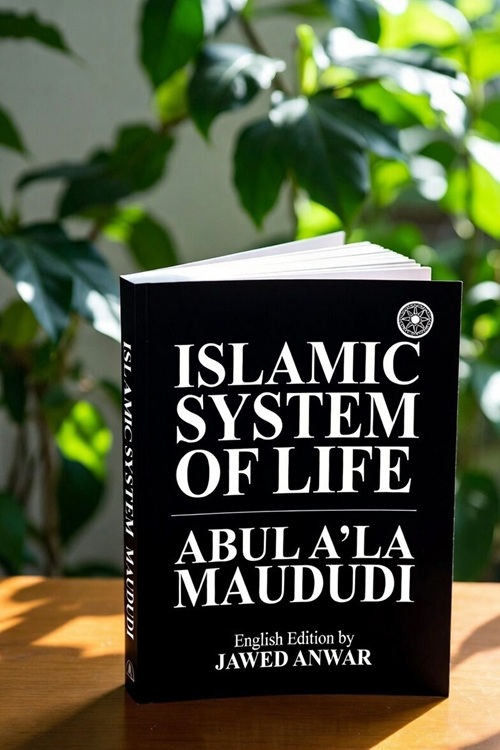
Islamic System of Life - Chapter 8: Jihad in the Path of God
Syed Abul A'la Maududi (1903–1979)
English Edition: Syed Jawed Anwar
[What does “jihad in the path of God” truly mean—and why is it so misunderstood today? Chapter 8 of Islamic System of Life by Abul A'la Maududi removes the myths and presents the clear, powerful reality.]
Jihad in the Path of God
All praise belongs to God, who created us, granted us reason and understanding, gave us the ability to distinguish right from wrong, and sent His best servants to guide us. Peace be upon those noble servants who taught humanity true humanity, showed people how to live with dignity, made them aware of the real purpose of life, and taught them the principles by which they can find peace in this world and salvation in the Hereafter.
Dear friends and respected audience!
The topic before us today is “Jihad in the Path of God.” This is not merely a historical or legal subject—it is one of the most important practical issues in religion. It is directly connected to the very purpose for which God sent His prophets and revealed His guidance.
Jihad is not just one of many acts of worship; it is a central pillar of the Islamic movement. Without understanding jihad correctly, we cannot understand Islam’s mission in the world. Without striving in jihad, we cannot fulfill our duty toward God and humanity.
The Common Misunderstanding
The word “jihad” is often translated as “holy war,” and for a long time, it has been explained in a way that makes it seem like fanatical frenzy. Upon hearing it, people picture religious zealots charging forward with swords, beards bristling, eyes bloodshot, shouting “Allahu Akbar.” They imagine seizing an unbeliever, placing a sword to his neck, and demanding: “Say ‘There is no god but Allah,’ or your head will be severed.”
Scholars have painted this image with great artistry, and beneath it, in bold letters, they’ve written: “The scent of blood emanates from this nation’s tales.” The irony is that the creators of this portrait are often our so-called benefactors—those who themselves have waged utterly unholy wars for centuries. Their own image is one of greed for wealth and power: armed with every kind of weapon, they swoop down on the world like pirates, searching for markets, raw materials, colonies, and mineral mines to fuel their insatiable fire of avarice.
Their wars are fought not in the path of God but in the path of the stomach, lust, and ego. For them, a sufficient reason to attack a nation is that its land holds mines, produces goods, has oil, can absorb their factory output, or can accommodate their surplus population. If nothing else, the nation’s crime is simply existing in the path to a country they already control or now wish to conquer.
What Muslims did belongs to the distant past, while their deeds are current events unfolding before the world day and night. Asia, Africa, Europe, America—what part of the globe remains untouched by their unholy war, not turned into a blood-soaked garden?
Yet their skill is remarkable. They’ve made our image so horrific and repulsive that their own hides behind it. And our naivety is equally noteworthy. When we saw this portrait painted by outsiders, we were so horrified that we forgot to look behind it and see the artists’ true faces.
Instead, we began apologizing: “Sir! How could we know war and killing? We are peaceful preachers, like monks and priests. Our work is merely to refute a few religious beliefs and get people to accept others in their place. What do we have to do with swords? Though, admittedly, sometimes when someone came to kill us, we raised our hands in response. But now we’ve repented even of that. For your peace of mind, sword-based jihad has been officially abolished. Now jihad is just the effort of tongue and pen. Firing cannons and guns is the government’s job; wielding tongue and pen is ours.”
Causes of Misconceptions About Jihad
From a purely academic perspective, when we analyze why understanding the reality of “jihad in the path of God” has become difficult—not just for non-Muslims but even for Muslims—we find two major fundamental misconceptions.
The first is viewing Islam as a “religion” in the usual sense of the word. The second is seeing Muslims as a “nation” in the conventional meaning. These two misconceptions haven’t just distorted the issue of jihad; they’ve altered the entire picture of Islam and completely misrepresented the position of Muslims.
In common usage, “religion” means a collection of beliefs, worship practices, and rituals. In this sense, religion is a private matter. You have the right to hold whatever belief you want and worship however your conscience accepts. At most, if you have zeal, you can preach your beliefs and debate with others. What occasion is there to take up the sword? Do you want to force people to share your beliefs by killing them? This question inevitably arises if you label Islam as a “religion” in the ordinary sense. And if that were truly Islam’s position, there would be no justifiable reason for jihad.
Similarly, a “nation” means a homogeneous group of people who, sharing certain basic elements, unite among themselves and distinguish from others. In this sense, a nation takes up arms for only two reasons: either someone attacks to seize its legitimate rights, or it attacks to seize others’ legitimate rights.
In the first case, there is at least some moral justification for raising arms (though some consider even this illegitimate). But the second case—no one except dictators calls it justified, not even the architects of vast empires like Britain and France dare claim it today.
The Reality of Jihad
Thus, if Islam is a “religion” and Muslims a “nation,” the entire significance of jihad—which Islam calls the most excellent of worship—vanishes. But the truth is that Islam is not a “religion” in that narrow sense, and “Muslim” is not the name of a “nation” in the conventional meaning.
In reality, Islam is a revolutionary ideology and program that seeks to alter the entire world’s social order and rebuild it according to its own ideology and program. Muslims are the name of that international revolutionary party which Islam organizes to implement its revolutionary program. And jihad is the revolutionary struggle and utmost exertion of power that the Islamic party employs to achieve this objective.
Like all revolutionary ideologies, Islam abandons common words and adopts its own specific terminology to distinguish its revolutionary concepts from ordinary ones. The word “jihad” belongs to this special terminology. Islam deliberately avoided Arabic words like “harb” (war) and others that mean “war,” and instead used “jihad,” which is synonymous with “struggle” but carries even greater emphasis. In English, its precise meaning can be expressed as: “To exert one’s utmost endeavor in furthering a cause.”
The question is: Why adopt this new word instead of the old ones? The answer is simple: “War” refers to the battles fought by nations and empires—and still fought today—for personal or group selfish interests, without any trace of supporting an ideology or principle.
Since Islam’s fight is not of that nature, it discards the word entirely. Islam is not concerned with the interests of one nation or the harm of another; it cares nothing about whether one empire or another holds sway over the earth. Its concern is human welfare. For this welfare, it holds a specific ideology and practical program. Wherever any government opposes this ideology and program, Islam seeks to eradicate it, regardless of the nation or country. Its aim is to establish the rule of its ideology and program, without regard to who carries its banner or whose rule it strikes.
It demands the earth—not just a portion, but the entire planet—not because the sovereignty of the earth should pass from one nation or several nations to a particular nation, but so that all humanity can benefit from the program of human welfare that it possesses—or, more accurately, the program of human welfare called “Islam.”
For this purpose, it wants to employ all forces that can bring about a revolution, and the comprehensive name for using all these forces is “jihad.” Changing people’s perspectives through the power of tongue and pen, creating a mental revolution in them—that is jihad. Overthrowing the old tyrannical system of life with the sword and establishing a new just system—that too is jihad. Spending wealth and exerting physical effort in this path is also jihad.
The Essential Qualifier: “In the Path of God”
But Islam’s jihad is not mere “jihad”; it is “jihad in the path of God.” The qualifier “in the path of God” is essential. This phrase also belongs to Islam’s special terminology. Its literal translation is “in the way of God.” This translation has led people into misunderstanding, thinking that forcibly making people followers of Islamic religious beliefs is jihad in the path of God—because narrow minds can’t conceive “the way of God” as anything else.
But in Islamic language, its meaning is much broader. Every act done for collective welfare and well-being, where the doer’s intention is not worldly gain but solely to earn God’s pleasure—Islam calls such an act “in the path of God.”
For example, if you give charity intending some material or moral return in this world, it is not in the path of God. But if your intention is to help a poor person and thereby earn God’s pleasure, it is in the path of God. Thus, this term is reserved for acts performed with complete sincerity, free from all selfish motives, based on the view that serving other humans’ welfare pleases God, and the goal of human life is nothing but earning the Creator’s pleasure.
The qualifier “in the path of God” is added to “jihad” for the same reason. It means that when a person or group rises to revolutionize the system of life and establish a new one according to Islamic belief and ideology, their uprising and sacrifices must have no selfish motive. Their aim should not be to remove Caesar and become Caesar themselves. There should be no trace of seeking wealth, fame, honor, or prestige for themselves in their struggle’s objectives.
All their sacrifices and efforts should aim solely to establish a just system of life among God’s servants. In return, they seek nothing but God’s pleasure: “Those who believe fight in the cause of God, and those who disbelieve fight in the cause of Taghut” (An-Nisa 4:76). “Taghut” means exceeding limits—using power to become a god over humans or extract more than one’s due share. In contrast, the war in God’s path aims only to establish God’s law of justice in the world.
The fighter must abide by it and enforce it on others. As the Quran states: “That home of the Hereafter We assign to those who do not desire exaltedness upon the earth or corruption. And the [best] outcome is for the righteous” (Al-Qasas 28:83). A hadith relates that a man asked the Prophet Muhammad (peace be upon him): “What is meant by fighting in God’s path? One fights for wealth, another for fame in bravery, a third out of enmity or national pride. Whose fight is in God’s path?” The Prophet replied: “None of theirs. In God’s path is only the fight of one who seeks nothing but to exalt God’s word.” (Sahih al-Bukhari) Another hadith states: “If someone fights and even the intention of gaining a camel’s rope enters their heart, their reward is lost.” (Sunan Abi Dawud) God accepts only acts done purely for His pleasure, without personal or group motives. Thus, the qualifier “in the path of God” holds special importance in the Islamic perspective.
The Revolutionary Call of Islam
The essence of Islam’s revolutionary call is: “O people, worship your Lord who created you” (Al-Baqarah 2:21). Islam does not call out to workers, landlords, farmers, or factory owners—it calls to all humans. It addresses humanity as humanity and says: If you obey and submit to anyone besides God, abandon it. If you yourselves harbor claims to divinity, cast them out of your minds, for none of you has the right to demand servitude or bow others’ heads. All of you must accept servitude to one God and stand equal in that servitude:
“Come to a word that is equitable between us and you—that we will not worship except God and not associate anything with Him and not take one another as lords instead of God” (Al Imran 3:64). This was a universal and total call for revolution. It proclaimed: “Legislation belongs to none but God” (Yusuf 12:40). No one has the right to become ruler over humans by their own authority, commanding or forbidding as they please. Considering any human as inherently sovereign is associating them with God in divinity, and this is the root of corruption in the world.
The reason humans deviate from the sound nature God created them with and the straight path He showed for life is that people forget God—and consequently forget their own reality. The inevitable result is that some individuals, families, or classes rise with open or hidden claims to divinity, using their power to exploit people unlawfully and make them servants. On the other side, this same forgetfulness of God and self leads some people to accept the lordship of the powerful and acknowledge their right to command, bowing their heads in obedience.
This is the foundation of injustice, corruption, and exploitation in the world, and Islam strikes directly at it. It calls out loudly: “And do not obey the order of the transgressors who cause corruption in the land and do not amend” (Ash-Shu’ara 26:151-152). “And do not obey him whose heart We have made heedless of Our remembrance and who follows his desire and whose affair is ever [in] neglect” (Al-Kahf 18:28). “God’s curse be upon the wrongdoers who avert [people] from the way of God and seek to make it [seem] deviant” (Hud 11:18-19). It asks people: “Are separate lords better or God, the One, the Prevailing?” (Yusuf 12:39). “If you don’t accept the servitude of this One God, you’ll never escape the mastery of these small, false gods. They’ll dominate you in some way and spread corruption: ‘Indeed, kings—when they enter a city, they ruin it and render the honored of its people humbled. And thus do they do’” (An-Naml 27:34). “And when he goes away, he strives throughout the land to cause corruption therein and destroy crops and animals. And God does not like corruption” (Al-Baqarah 2:205).
There’s no room here for full details. Briefly, I want to impress upon your minds that Islam’s call to monotheism and worship of God was not merely a religious belief in the usual sense, but in reality a call for social revolution. It directly clashed with the interests of the ruling powers and the classes supporting or supported by them.
That is why whenever a prophet raised the cry: “O my people, worship God; you have no deity other than Him” (Al-A’raf 7:59), the government of the time immediately opposed it, and all exploitative classes girded for battle. Because this was not just stating a metaphysical proposition—it was declaring a social revolution, and the scent of political upheaval was detected in the first voice.
Characteristics of Islam’s Revolutionary Call
There’s no doubt that all prophets (peace be upon them) were revolutionary leaders, and Prophet Muhammad (peace be upon him) was the greatest. But what clearly distinguishes worldly revolutionaries from these God-fearing revolutionary leaders—even if the former are well-intentioned—is that the latter could not achieve true justice and balance.
Worldly revolutionaries either rise from oppressed classes or with sympathy for them, viewing all matters from that perspective. Naturally, their view isn’t impartial or purely humanistic but biased toward one class. They devise remedies for oppression that result in counter-oppression. It’s impossible for them, free from revenge, envy, and enmity, to propose a moderate, balanced social system ensuring overall human welfare.
In contrast, the prophets (peace be upon them), no matter how persecuted or oppressed along with their companions, never let personal emotions affect their revolutionary movement. They worked under direct divine guidance, and since God is above human emotions, has no special tie to any class, and no grudge against another, the prophets viewed all matters with unbiased justice, considering what benefits all humans collectively. How to create a system where everyone stays within legitimate bounds, enjoys rightful entitlements, and achieves complete balance in individual relations and between individual and society.
This is why the prophets’ revolutionary movement never turned into class war. They didn’t reconstruct society by imposing one class over another but adopted a just method providing equal opportunities for progress and material-spiritual happiness for all humans.
The Need for Jihad and Its Objective
In this short essay, it’s difficult to present the details of the social order Islam proposes. God willing, that opportunity will come soon. Here, staying within my topic, what I needed to clarify is that Islam is not merely a religious belief and a set of worships—it’s a system that seeks to eradicate all tyrannical and corrupt systems of life from the world and implement its reformative program, which it considers best for human welfare and well-being.
For this destruction and construction, revolution and reform, it invites not one nation or group but all humans. It calls even those oppressive classes and exploitative groups—even kings and chiefs—to come and accept living within the legitimate bounds set by your Creator. If you accept the system of justice and truth, there is peace and security for you. There is no enmity with any human here. Whatever enmity exists is with oppression, corruption, immorality—with anyone exceeding their natural limits to seize what, per God’s nature, isn’t theirs.
Those who accept this call, regardless of class, race, nation, or country, become members of the Islamic party with equal rights and status. Thus forms the international revolutionary party that the Quran calls “God’s party,” also known as the “Islamic community” or “Muslim ummah.”
As soon as this party comes into existence, it begins jihad to achieve its purpose. Its very existence demands that it strive to eradicate non-Islamic rule and establish the balanced code of civilization and society that the Quran comprehensively terms “God’s word.”
If this party doesn’t strive to change the government and establish Islamic governance, its very purpose is defeated—because it wasn’t formed for any other goal, and its existence has no other use besides this jihad.
The Quran states its sole purpose of creation: “You are the best nation produced [as an example] for mankind. You enjoin what is right and forbid what is wrong and believe in God” (Al Imran 3:110). This is not a group of religious preachers and missionaries but God’s enforcers: “That you become witnesses over the people” (Al-Baqarah 2:143). Its task is to forcibly eradicate oppression, strife, corruption, immorality, transgression, and exploitation from the world—end the lordship of “lords besides God”... replace evil with good. “And fight them until there is no fitnah [persecution] and [until] worship is [acknowledged to be] for God” (Al-Baqarah 2:193). “If you do not do it, there will be fitnah on earth and great corruption” (Al-Anfal 8:73)... “It is He who has sent His Messenger with guidance and the deen of truth to manifest it over all deen, even though they who associate others with God detest it” (At-Tawbah 9:33).Therefore, this party has no choice but to seize governmental power, because a corrupt civilizational system stands on the strength of a corrupt government, and a righteous system can’t be established until power is wrested from corrupters and given to reformers.
Apart from world reform, it’s impossible for this community to practice its own program under another program’s rule. No party believing in a system can live according to it under an opposing system’s government.
A socialist in England or America couldn’t successfully live by socialism, because the capitalist system would be forcibly imposed by governmental power, inescapable. Similarly, a Muslim can’t successfully live by Islamic principles under a non-Islamic government. Laws they consider false, taxes they deem unlawful, transactions they see as illegitimate, culture and lifestyle they view as corrupt, education methods they find deadly—all would be imposed on them, their homes, their children, with no escape.
Thus, anyone or group holding a conviction is compelled by its nature to strive to eradicate the opposing program’s rule and establish their own—because under the opponent’s rule, they can’t practice their program. If they neglect this effort, it clearly means they’re false in their beliefs: “May God pardon you, [O Muhammad]; why did you give them permission [to remain behind]? [You should not have] until it was evident to you who were truthful and you knew [who were] the liars. Those who believe in God and the Last Day do not ask permission of you to be excused from striving with their properties and their lives...” (At-Tawbah 9:43-45). In these words, the Quran gives a clear, explicit verdict: the sole criterion for a community’s truthfulness in its conviction is striving with life and wealth to make its program sovereign. If you tolerate an opposing program’s rule, it’s conclusive proof you’re false in your belief—and the natural result is that eventually even your nominal belief in Islam’s program won’t remain. Initially, you’ll tolerate the opposing rule reluctantly; gradually, your hearts will grow accustomed, turning reluctance to inclination; finally, you’ll become helpers in establishing and maintaining the opposing rule, expending life and wealth so that non-Islam prevails over Islam.
Your own strengths will be used to resist Islam’s establishment, and at that point, you’ll differ from disbelievers only in a hypocritical claim to Islam—a worst lie, a deceptive name.
The Prophet (peace be upon him) clearly stated this outcome in a hadith: “By Him in whose hand is my soul, you must enjoin good and forbid evil, seize the oppressor’s hand and force him to truth, or God’s law of nature will manifest: the effect of the wicked’s hearts will enter yours, and you’ll be cursed like them.”
A Universal Revolution
From this discussion, it should be clear that the objective of Islamic jihad is to eradicate non-Islamic governance and establish Islamic rule. Islam wants to bring this revolution not just in one country or a few but throughout the world.
Though initially, members of the Muslim party must create revolution in the governance systems where they live, their ultimate goal is nothing less than a world revolution.
No revolutionary ideology rising on principles of human welfare rather than nationalism can limit its objectives to one country or nation. By its nature, it’s compelled to aim for world revolution. Truth refuses geographic boundaries: if it’s true on one side of a mountain or river, it’s true on the other. No part of humanity should be deprived of it.
Wherever humans are victims of oppression and excess, it’s my duty to reach and help. The Quran expresses this vision: “And what is [the matter] with you that you fight not in the cause of Allah and for the oppressed among men, women, and children who say, ‘Our Lord, take us out of this city of oppressive people’” (An-Nisa 4:75).Moreover, despite national and territorial divisions, human relations have such universality that no country can fully implement its principles unless neighboring countries adopt the same.
Thus, for general reform and self-preservation, the Muslim party can’t suffice with establishing Islamic rule in one region but must strive to expand it as far as its strengths allow. On one hand, it will spread its ideas and invite all countries’ inhabitants to accept the program holding true welfare. On the other, if it has power, it will fight to eradicate non-Islamic governments and establish Islamic rule.
This was the policy followed by Prophet Muhammad (peace be upon him) and the Rightly Guided Caliphs after him. Arabia, where the Muslim party originated, was first brought under Islamic rule. Then the Prophet invited surrounding countries to his principles and prepared for military action against them. The Battle of Tabuk was the beginning of this chain. When Abu Bakr (may God be pleased with him) became leader, he attacked the non-Islamic governments of Rome and Persia. Umar (may God be pleased with him) brought these attacks to final success. The people of Egypt, Syria, Rome, and Persia initially saw this as Arab imperialist policy, thinking one nation was out to enslave another as before. Due to this misconception, they fought under Caesar and Khosrau’s banners.
But when the Muslim party’s revolutionary program became clear—that they weren’t bearers of aggressive nationalism but free of national motives, come only to establish a just system and end the lordship of oppressive classes destroying us under Caesarism and Khosraism—their moral sympathies shifted to the Muslim party. They abandoned Caesar and Khosrau’s banners, and if conscripted, fought half-heartedly.
This is the reason for the astonishing victories Muslims achieved in the early period, and why, after Islamic rule was established and people saw the Islamic social system in action, they joined this international party and became bearers of its program, advancing to spread it in other countries.
The Division of Offensive and Defensive Is Irrelevant
When you reflect on what I’ve described, you’ll easily see that the division of war into “offensive” (aggressive) and “defensive” doesn’t apply to Islamic jihad at all. This division only fits national and territorial wars, as “attack” and “defense” are terms used relative to a country or nation.
But when an international party rises with a global faith/ideology, includes all nations on human grounds, and struggles only to eradicate opposing ideology’s rule and establish its own, no question of terminological attack or defense arises. Even ignoring terminology, the offensive-defensive division doesn’t fit Islamic jihad.
Islamic jihad is simultaneously offensive and defensive. Offensive because the Muslim party attacks the opponent’s rule; defensive because it’s compelled to seize governmental power to practice its own program. As a party, it has no “home” to defend—only its principles to uphold. Similarly, it doesn’t attack the opponent’s “home” but their principles, not to forcibly seize them but to wrest governmental power from them.
The Status of Non-Muslims (Dhimmis)
This also resolves the question of the status of people following other beliefs or programs once Islamic rule is established in a country. Islam’s jihad doesn’t interfere with people’s beliefs, programs, worship methods, or social laws—it gives them full freedom to adhere to whatever belief and follow whatever program they wish.
However, it refuses to acknowledge their right to run the governmental system in a way Islam considers corrupt. It also doesn’t allow them to continue practices under Islamic rule that Islam sees as deadly to social welfare. For example, it will immediately block all forms of usury. It won’t permit gambling at all, will stop all sales, purchases, and financial dealings forbidden in Islamic law. It will completely shut down brothels and dens of vice. It will compel non-Muslim women to observe minimal modesty standards and prevent pre-Islamic displays of adornment. It will regulate cinema. There are many such matters where an Islamic government, for social welfare and its own self-defense, won’t allow civilizational practices permissible in non-Muslims’ programs but corruptive and destructive in Islam’s view.
If anyone accuses Islam of intolerance here, they should note that no other ideology has shown as much tolerance to others as Islam. Elsewhere, you’ll see non-conformists’ lives made miserable, even forced to flee their homeland. But Islam gives non-conformists full security and opportunities for progress, treating them with generosity unmatched anywhere.
The Suspicion of Imperialism
Here, I must reiterate that in Islam’s view, jihad is only that which is purely in God’s path. When Islamic rule is established through such jihad, Muslims have no right to become Caesars or Khosraus. A Muslim doesn’t fight—and can’t as a Muslim—to establish personal rule, enslave God’s servants, or unlawfully collect people’s hard-earned money to build paradises on earth for themselves. That is not jihad in God’s path but in Taghut’s path, and such rule has nothing to do with Islam.
Islam’s jihad is a dry, unrewarded labor involving only sacrifice of life, wealth, and desires. If successful and power is gained, true Muslim rulers bear such heavy responsibilities that even nighttime sleep and daytime comfort become forbidden. But in return, they can’t enjoy the pleasures of power and rule for which people generally seek government.
Islam’s ruler is no superior entity distinguished from common subjects; they can’t sit on thrones of grandeur, can’t make anyone bow, can’t move a leaf against Sharia law, have no authority to shield a relative, friend, or themselves from even the humblest person’s rightful demand, can’t take a grain unjustly or occupy an inch of land.
A salary sufficient for an average Muslim’s living is the maximum they can take from the treasury; more is forbidden. They can’t build grand palaces, keep servants, or amass luxuries. They live in constant fear of strict accountability for their deeds—if even a forbidden penny, an inch of forcibly taken land, a trace of arrogance or pharaonic behavior, a spot of injustice, or a hint of serving desires appears, they’ll face severe punishment.
If someone is truly worldly greedy, they’d be the biggest fool to accept Islamic governance under its law—because even an ordinary market shopkeeper has a better position than an Islamic ruler. The shopkeeper earns more than the Khalifa (caliph) daily and sleeps soundly at night; the poor Khalifa gets neither equal income nor peaceful sleep.
This is the fundamental difference between Islamic and non-Islamic government. In non-Islamic government, the ruling group establishes its lordship and uses the country’s resources for itself. In contrast, in Islamic government, the ruling group merely serves and gains nothing more than common inhabitants.
Compare the lifestyle and conduct of Islamic government’s civil servants to those today or even to the imperialist powers of that era—you’ll see the essential difference between Islam’s world-conquest and imperialism’s globalism.
In Islamic government, governors of Khorasan, Iraq, Syria, and Egypt lived with the utmost simplicity, far below the extravagance common among ordinary officials of other systems. Khalifa Abu Bakr Siddiq (may God be pleased with him) led such a vast empire while maintaining the most modest standard of living. Umar (may God be pleased with him) followed the same path, even as the treasury overflowed with the wealth of two great empires.
Though superficially both imperialism and Islam conquer lands, their essences differ like earth and sky: “Their flight is in the same sky, but the vulture’s world is one, the falcon’s another.”
This is the reality of the jihad you’ve heard so much about.
Now, if you ask me where this concept of Islam, the Muslim community, and jihad that I’m presenting has vanished, and why no trace exists among Muslims worldwide, I’ll say: don’t ask me, ask those who diverted Muslims’ attention from their true mission to amulets, talismans, incantations, meditations, and austerities. Those who prescribed shortcuts for salvation, welfare, and goals—so everything could be obtained by chanting beads or gaining a grave-dweller’s favors, without struggle or sacrifice. Those who bundled Islam’s universals, principles, and objectives into dark corners, entangling Muslims’ minds in endless debates over reciting “Amin” aloud, raising hands, transferring rewards, visiting graves, and such minutiae that they forgot themselves, their purpose of creation, and Islam’s reality.
If that doesn’t satisfy you, pose the question to those princes, officials, and power-holders who claim faith in the Quran and Muhammad (peace be upon him) but accept no more right of the Quran’s law and the Prophet’s guidance over themselves than occasionally holding Quran recitations, Eid Milad gatherings, or having God (God forbid) applaud their poetry. As for implementing that law and guidance, these gentlemen consider themselves exempt—because their selves aren’t ready to accept the restraints and bear the responsibilities Islam imposes. They seek cheap salvation.
Recent posts
-
Islamic System of Life - Chapter 9: Bearing Witness to the Truth
09 February 2026 -
Islamic System of Life - Chapter 7: Construction and Destruction
08 February 2026 -
Islamic System of Life - Chapter 6: The Moral Foundations of the Islamic Movement
08 February 2026 -
Islamic System of Life - Chapter 5: Islam’s Ethical Perspective
04 February 2026 -
Islamic System of Life - Chapter 4: The True Deen (Way of Life)
26 January 2026 -
Islamic System of Life - Chapter 3: Islam and Jahiliyyah (Ignorance)
25 January 2026