
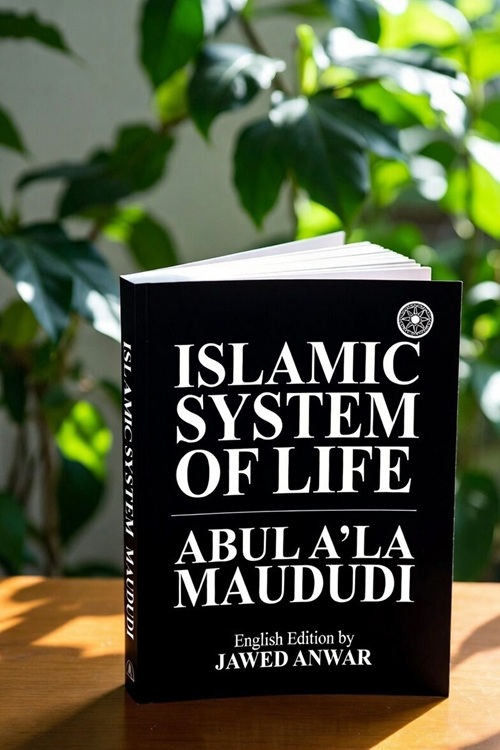
Islamic System of Life - Chapter 7: Construction and Destruction
Syed Abul A'la Maududi (1903–1979)
English Edition: Syed Jawed Anwar
[Why do nations rise and fall? What decides whether a society builds or destroys? Chapter 7 of Islamic System of Life by Abul A'la Maududi gives a clear, timeless answer rooted in God’s unchanging law.]
Praise and Gratitude
All praise and thanks belong to God, who created us, granted us reason and understanding, gave us the ability to distinguish right from wrong, and sent His best servants to guide and show us the way. Peace be upon those noble servants of God who taught humanity true humanity, showed people how to live with dignity, made them aware of the real purpose of life, and taught them the principles by which they can find peace in this world and salvation in the Hereafter.
Dear friends and respected audience!
The world we live in was created by a God who does not act randomly or carelessly. He is not an absolute ruler who leaves His kingdom in darkness and chaos. He governs everything according to a firm, unchanging law and a strong, consistent system.
Just as the sun, moon, earth, and stars move according to His fixed laws; just as our birth, death, childhood, youth, old age, breathing, digestion, blood circulation, health, and sickness all follow His precise and unyielding rules—so too does He have a law that governs the rise and fall of nations, our progress and decline, our personal, national, and collective destinies. This law is just as firm, impartial, and unbreakable.
It is impossible for a person to breathe through their eyes instead of their nose or digest food in their heart instead of their stomach. In the same way, it is impossible for a nation to rise by following a path that God’s law has destined for decline. If fire is hot for one person, it is not cold for another. In the same way, actions that God’s law declares evil cannot lift one person while destroying another.
The principles God has set for human well-being and ruin do not change for anyone. They cannot be avoided, delayed, or bent by favoritism or enmity.
The first and most important rule of God’s law is this: He loves construction and hates destruction.
Who Does God Entrust with Managing the World?
As the Owner, God desires that His world be managed properly. He wants it improved as much as possible. He wants the resources He has provided and the abilities He has granted to be used in the best possible way. He never likes—and it cannot be expected that He would ever like—His world to be ruined, destroyed, filled with disorder, filth, oppression, and tyranny.
Among human beings, God entrusts authority to those who show the greatest capacity to build. He gives the responsibility of managing the world to those who are most capable of construction.
Those Who Destroy More Are Removed
Then God watches: How much do they build, and how much do they destroy? As long as their construction outweighs their destruction—and no better alternative exists who builds more and destroys less—the management of the world remains in their hands, despite their many faults and shortcomings.
But when their destruction begins to outweigh their construction, God removes them and hands over responsibility to others—under the same unchanging condition.
The Example of the Garden Owner and the Gardener
This law is completely natural. Your own reason will confirm that it must be this way.
Suppose you own a garden and entrust it to a gardener. What is the first thing you want from him?
You do not want the garden ruined. You want it improved, beautified, and made more productive. You want its beauty, cleanliness, and yield to increase as much as possible.
If you see a gardener who works hard, with care and skill, improving the garden—tending the good trees, clearing away weeds and thorns, adding new and better varieties of flowers and fruits—you will be pleased with him. You will promote him and never want to remove such a capable, dutiful, and devoted worker.
But if you see the opposite—if the gardener is incompetent, lazy, and careless; if the garden fills with filth; if paths break, water is wasted in some places and lacking in others; if weeds and thorns grow unchecked while good trees wither; if useful plants are cut down mercilessly—then tell me honestly: How can the garden’s owner be pleased with such a person?
What recommendation, what pleading, what ancestral rights or self-made claims can convince the owner to leave his garden in the hands of someone who is destroying it?
At most, he may warn him and give him another chance. But if the gardener still does not change and continues ruining the garden, the only solution is for the owner to remove him and replace him with someone else.
Now consider: If you act this way toward your small garden, how can God—the One who entrusted this vast earth with all its resources and gave humans such wide authority—ignore whether people are building or destroying His world?
If you are building, there is no reason for Him to remove you. But if you do little building and much destroying—if you ruin His magnificent garden—then no matter how strongly you claim rights based on your own assumptions, He will not accept your claim to manage it.
He may warn you, give you chances to reform, but in the end, He will remove you from authority and entrust it to others.
The Difference Between God’s Perspective and Human Perspective
In this matter, God’s perspective differs from human perspective in the same way a garden owner’s perspective differs from his gardener’s.
Suppose a family of gardeners has worked in one person’s garden for generations. Their grandfather was hired for his skill. His descendants also worked well. The owner thought: “Why remove them and try new people when they are doing a good job? They have a stronger claim.”
So the family became firmly established in the garden. But now the new generation is incompetent, careless, lazy, and ungrateful. They lack gardening skill. They ruin the entire garden. Yet their claim is: “We have been here for generations. Our ancestors first cultivated this garden. We have hereditary rights. It is unjust to remove us and give the job to someone else.”
This is the gardeners’ perspective. But can the garden owner share this view? Will he not say: “My primary concern is the proper management of my garden. I did not create this garden for your ancestors—I hired your ancestors for the garden. Any rights you have are conditional on service and competence. If you improve the garden, I will respect your rights. I have no enmity toward old gardeners. Why should I remove them unnecessarily and experiment with new ones when they are doing well?”
But if they ruin the garden they were hired to maintain, the owner will say: “Your rights are conditional. You have no claim if you destroy what you were entrusted to improve. Other capable candidates exist. I will hand over management to them, and you will serve under them.”
If even then they prove useless—even as subordinates—and continue causing harm, the owner will remove them entirely and bring in new people to live and work there.
This difference between the owner’s view and the gardeners’ view is exactly the same as the difference between God’s view and the view of people on earth.
Different nations live on different parts of the earth. Their claim is: “This land is our national homeland. Our ancestors have lived here for generations. We have birthrights over it. Therefore, only we should manage it—no outsider has the right to come and take control.”
But the true Owner of the earth—God—does not recognize these national birthrights. He never said: “Every land belongs forever to its inhabitants, whether they build it up or tear it down.”
He looks at what the people do with their land. If they build and improve—if they use their powers for reform and progress, suppress evil, promote good—then God says: “You deserve to manage it. You were here first, and you are capable. Your right takes precedence over others.”
But if the opposite happens—if they do little building and much destruction—if they fill God’s earth with corruption, filth, and oppression—then God first sends mild and then severe warnings to awaken them and make them reform.
When they still do not change, He removes them from authority and entrusts the land to others who—at the very least—are better than them in building and less destructive.
And the matter does not end there. If even as subjects they show no competence—if they prove they can only destroy—then God wipes them out and brings others to take their place.
In this matter, God’s perspective is always that of the true Owner. He does not look at ancestral, national, or birth-based claims. He looks at who builds more and destroys less. Among current candidates, He selects those who prove most capable. As long as their construction outweighs their destruction—or until someone better appears who builds more and destroys less—management remains with them.
Historical Evidence
History bears witness that God has always managed His earth according to this principle. Look no further than your own country’s (India) history.
The nations that once lived here lost their constructive abilities. God gave opportunity to the Aryans, who at that time possessed the best qualities among contemporary peoples. They built a grand civilization, invented many sciences and arts, extracted the earth’s treasures and used them well, and did far more building than destruction.
As long as they possessed these abilities, they remained the managers of this land despite all ups and downs. Other challengers rose but were pushed back, because no better alternative existed.
Their invasions served only as warnings when these people began to decline—when their construction decreased and destruction increased, when moral decay appeared (whose traces you can still see in the caste system), when they divided humanity into varnas and castes, creating a ladder-like society where each rung treated the one above as master and the one below as servant, when they oppressed millions of God’s servants (traces of which remain in untouchability), when they closed the doors of knowledge to common people and sat like snakes guarding the treasures of learning, when their ruling classes forgot responsibility and focused only on extracting benefits—often unjustly—then God finally took management away from them.
He brought people from Central Asia who had been influenced by the Islamic movement and were adorned with better qualities of life. These people ruled successfully for centuries. Many local people joined them by accepting Islam.
There is no doubt they also caused some destruction, but their construction far outweighed it. Whatever progress and reform took place in India for hundreds of years happened through their hands or under their influence. They spread knowledge, reformed ideas, improved civilization and society significantly, used the land’s resources well by the standards of their time, and established a system of peace and justice that—though far below Islam’s true standard—was high compared to previous conditions and neighboring countries.
Then they too began to decline, like those before them. Their constructive abilities weakened, and destructive tendencies grew. They too divided their society with high-low distinctions and racial prejudices, causing countless moral, political, and cultural harms. They too began to oppress more than they did justice. They too forgot the responsibilities of government and focused only on extracting benefits—often unjustly. They too abandoned progress and reform, wasting God’s gifts or using them mostly for destruction.
They became so absorbed in ease and luxury that when their final defeat came and their rulers had to leave Delhi’s Red Fort, their princes—once candidates for rule—could not even flee on foot. They had forgotten how to walk on the earth.
Muslim moral decline reached such a level that—from the common people to the highest officials—loyalty remained only to self. Selling religion, nation, and country became common.
Millions became professional soldiers whose moral condition was like that of pet dogs: whoever feeds them owns them and can use them to hunt as desired. They felt no shame that this lowly profession allowed their enemies to conquer them with their own hands.
Even a great poet like Ghalib boasted: “For generations my family has been in the profession of soldiery.” It never occurred to him that professional soldiery was nothing to boast about—it was something to die of shame over.
When their condition became this bad, God decided to remove them. The management of India once again opened for new candidates.
At that moment, four candidates stood in the field: Marathas, Sikhs, British, and some Muslim nobles. Judge fairly—without national bias—by looking at the history of that era and what followed.
None of the other candidates had the constructive abilities the British possessed, nor did their destruction outweigh the British destruction. In terms of basic ethics and use of natural sciences, the others were not superior.
Whatever the British built, none of the others would have built. Whatever they destroyed was far less than what the others would have destroyed.
Absolutely speaking, you will see many evils in the British. But comparatively, their evils were far fewer, and their good qualities far greater, than their rivals.
That is why God’s law once again broke humanity’s self-made principle: “Every land belongs to its people forever, whether they build or destroy.”
History’s unchanging verdict proved: No. The Owner is God. He alone has the right to decide who manages His land and who loses it. His decision is not based on racial, national, or ancestral rights—but on who builds more and destroys less.
Among the candidates of that time, He chose those who proved most capable. As long as their construction outweighed their destruction—or until someone better appeared who built more and destroyed less—management remained with them.
India’s Freedom
We stand at one of history’s critical moments—when the true Owner of the earth ends one management and decides another.
Do not be deceived by the apparent transfer of power. This is not a final decision to hand the country’s management to its own people simply because foreigners are leaving. God did not bring outsiders without reason, nor is He removing them without reason. He did not previously take management from you arbitrarily, nor is He now handing it back arbitrarily.
In reality, India’s inhabitants are now candidates. Hindus, Muslims, Sikhs—all are candidates. Because they were already here, they are being given the first opportunity. But this is not permanent—it is a test.
If they prove that their constructive abilities outweigh their destructive ones, their appointment will become permanent. Otherwise, by showing more destruction than construction, they will quickly see management taken from them and given to one of the nearby nations.
Then they will have no right to protest. After openly proving their incompetence before the whole world, what face will they have to complain? Even if they shamelessly protest, who will listen?
Now consider honestly: At this moment—when the destiny of India is being decided—what proof of ability and character are the people of this land presenting before God? This was the time to outdo one another in showing the highest qualities and best abilities, so God would deem them worthy of managing His land.
Instead, the competition among Hindus, Muslims, and Sikhs is over who can destroy more—who can be more ruthless and oppressive—so they may earn the greatest share of God’s curse.
These are not signs of freedom, progress, or honor. There is fear that—for a long period—slavery and humiliation may be written for us again.
Therefore, those who have sense must think about reforming these conditions. At this stage, a question naturally arises in your mind: What is the way to reform?
I am ready to answer.
A Ray of Hope
In this darkness, one ray of hope remains for us: Not everyone in our population has become corrupt. At least four or five percent have been saved from this widespread moral disease.
This is the capital we can use to begin reform. The first step is to identify and organize this righteous element.
Our misfortune is that evil is organized and works systematically, while goodness remains scattered. Righteous people exist, but they are disconnected—no unity, no cooperation, no shared program, no common voice. This has rendered them completely ineffective.
Sometimes a servant of God cries out when he sees evil around him—but when no voice supports him, he sits down disappointed. Sometimes someone openly speaks truth and justice—but organized evil forcibly silences him, and the righteous quietly applaud from their places.
Sometimes someone cannot bear to see humanity’s blood being shed and protests—but oppressors crush him in crowds, and the sight discourages many whose consciences still have some life left.
This situation must end. If we do not want our country to fall under God’s punishment—where the good and bad alike are caught—we must strive to organize the righteous elements who have escaped this moral plague and confront the growing crisis with collective strength before it leads us to destruction.
The Way to Reform
Do not be discouraged that this righteous element is currently a small minority. If these few people organize—if their personal and collective conduct stands firmly on pure truth, justice, righteousness, sincerity, and honesty—and if they have a good program to solve life’s problems and run the world’s affairs correctly—then believe me: Organized goodness will ultimately defeat organized evil, despite evil’s large armies and dirty weapons.
Human nature is not fond of evil. It can be deceived and distorted to a great extent, but the innate love of goodness that the Creator placed within it cannot be completely erased.
Few people are devoted followers of evil or champions of wrongdoing. Few have true love for goodness and strive to establish it.
Most ordinary people stand between these two groups—with mixed inclinations toward good and evil. They are not devoted to evil, nor do they have extraordinary attachment to good. Which way they lean depends entirely on which side—champions of good or evil—steps forward and pulls them.
If champions of good do not enter the field and make no effort to guide the masses to the path of virtue, the field will inevitably belong to champions of evil. They will pull the masses onto their path.
But if champions of good are present and fulfill their duty of reform properly, evil’s influence over the masses cannot last long. Ultimately, the contest will be in the field of ethics—and in that field, good people can never be permanently defeated by bad people.
Truth will ultimately triumph over falsehood, honesty over deceit, purity over immorality—no matter how much force evil applies. The world is not so senseless that—after tasting the sweetness of good character and the bitterness of bad—it decides bitterness is better.
Besides organizing righteous people, reform requires a clear understanding of what “construction” (banao) and “destruction” (bigad) mean. We must understand destruction clearly so we can stop it, and construction clearly so we can pursue it fully.
There is not time for details here. I will present a brief picture of both.
Human destruction arises from four main causes:
- Lack of fear of God—which is the root of injustice, cruelty, betrayal, and all moral evils in the world.
- Independence from God’s guidance—which leaves no fixed moral principles for any matter. Personal, group, and national conduct becomes based on self-interest and desire. People no longer distinguish lawful from unlawful in goals or means.
- Selfishness—which turns into racism, nationalism, and class prejudice, producing countless forms of corruption.
- Stagnation or deviation—which causes people either to waste God’s gifts or misuse them.
In contrast, what builds and improves human life falls under four main headings:
- Fear of God—the only reliable guarantee against evil and for steadfastness on the right path. Truthfulness, justice, trustworthiness, righteousness, self-control, and all virtues on which a peaceful, progressive civilization depends grow from this one seed. Though some virtues can be produced to a limited extent by other beliefs (as Western nations have done somewhat), they reach a limit and remain shaky. Only fear of God provides a firm foundation for goodness across all human affairs.
- Following divine guidance—which binds personal, social, national, and international conduct to fixed moral principles. Without this, people proclaim one set of principles in books and apply another in practice. They change standards according to interest. Only divine guidance gives unchanging principles based on truth—not self-interest.
- A system of humanity—based on equality of status and rights for all, without unjust distinctions, high-low divisions, untouchability, or artificial prejudices. A system with enough breadth for all people on earth to participate equally.
- Righteous action—fully and correctly using God’s gifts of power and resources.
Dear friends! These four things together are what we call “construction” and “reform.” Our well-being depends on having an organized group of righteous people who work tirelessly to stop destruction and promote these forms of construction.
If this effort succeeds in bringing the people of this land onto the straight path, God is not unjust—He will not arbitrarily take management away from the original inhabitants and give it to others.
But if—God forbid—this effort fails, we cannot say what our fate, your fate, and the fate of this land’s people will be.
Recent posts
-
Islamic System of Life - Chapter 9: Bearing Witness to the Truth
09 February 2026 -
Islamic System of Life - Chapter 8: Jihad in the Path of God
08 February 2026 -
Islamic System of Life - Chapter 6: The Moral Foundations of the Islamic Movement
08 February 2026 -
Islamic System of Life - Chapter 5: Islam’s Ethical Perspective
04 February 2026 -
Islamic System of Life - Chapter 4: The True Deen (Way of Life)
26 January 2026 -
Islamic System of Life - Chapter 3: Islam and Jahiliyyah (Ignorance)
25 January 2026