
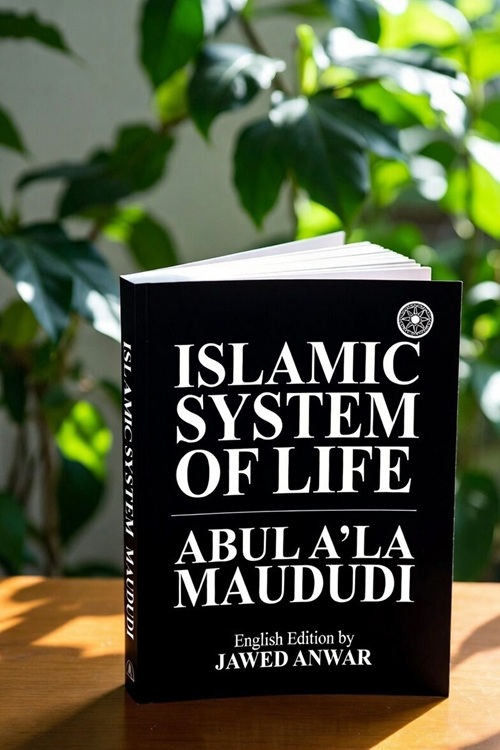
Islamic System of Life - Chapter 4: The True Deen (Way of Life)
Syed Abul A'la Maududi (1903–1979)
English Edition: Syed Jawed Anwar
[What is the one true way of life according to God? Chapter 4 of Islamic System of Life by Maulana Syed Abul A'la Maududi powerfully answers this question through the Quran’s own declaration: “Indeed, the [true] deen in the sight of Allah is Islam” (Al Imran 3:19).]
The Quran invites all humanity to the way of life it presents with a clear and bold claim: “Indeed, the [true] deen in the sight of Allah is Islam.” (Al Imran 3:19)
This short verse forms the heart of my discussion here. I will explain its meaning briefly to make clear what claim is actually being made. Then I will examine whether this claim should be accepted. Finally, I will outline what accepting it truly requires.
Most people interpret this verse simply as: “The only true religion in God’s sight is Islam.” And when they hear “Islam,” they usually picture a religion that began in Arabia about 1,400 years ago, founded by Prophet Muhammad (peace be upon him). Many—even some well-educated Muslims—refer to him as the “founder of Islam.”
So when a non-Muslim reads this verse, they often think: “This is just another religion claiming to be the only true one, like all the others.” And many Muslims pass over it quickly because they already believe Islam is true. If they do reflect, they usually compare Islam with Christianity, Hinduism, Buddhism, or other faiths to prove its superiority.
But this verse deserves far deeper attention than it usually receives. To understand the Quran’s claim properly, we must first clarify what “the religion” (al-deen) and “Islam” really mean here.
The Meaning of “Al-Deen” (The Way of Life)
In Arabic, the word “deen” carries several meanings: dominance, submission, recompense, or a way of life and conduct. In this verse, it means a complete way of life—a system of thought and action that people follow.
But the Quran does not say a deen; it says “al-deen”—the way of life. This is like the difference in English between saying “this is a way of life” and “this is the way of life.” The Quran is not claiming that Islam is one valid path among many. It claims that Islam is the one true and correct way of life in God’s sight.
Moreover, the Quran uses “deen” in its broadest sense. It does not refer to just one aspect of life (like worship or personal beliefs). It means the complete system for all of human life—individual and collective, personal and social, in every time and place.
The Quran is not saying: “In God’s view, the correct set of rituals, beliefs about the afterlife, and spiritual ideas is what we call Islam.” Nor is it saying: “The correct religious worldview (in the narrow Western sense of ‘religion’) is Islam.” Nor does it mean: “This system was right only for Arabs, or for people before the Industrial Revolution, or for a particular era.”
Instead, the Quran declares plainly: For all humanity, in every age and every place, there is only one correct way to live on this earth according to God—and that way is called “al-Islam.”
I was surprised to hear certain modern interpretations—especially from some writers—that limit “deen” to a personal relationship between the individual and God, excluding civilization, governance, and society. After eighteen years of careful study of the Quran, I can confidently say: The Quran never uses “deen” in such a narrow way. It always means the full system of thought and action for all human life, individual and collective, across all times.
The Meaning of “Al-Islam”
Now consider the word “Islam.” In Arabic, it means submission, surrender, yielding, and entrusting oneself completely.
But the Quran does not simply say “Islam”; it says “al-Islam”—the Islam. This is a specific term with deep meaning: complete submission and surrender to God alone, accepting His authority, giving up one’s own independence in thought and action, and entrusting oneself fully to Him.
This submission does not mean passively yielding to the laws of nature (as some have suggested). Nor does it mean following whatever ideas or experiences a person imagines or observes about God’s will (as others have misunderstood). Instead, it means: God has clearly shown humanity the correct way of thought and action through His prophets. A person accepts this revealed guidance and gives up self-directed thinking and behavior—surrendering to God’s way.
This is what the Quran calls “al-Islam.”
It is not a new religion (deen) invented 1,400 years ago in Arabia by Prophet Muhammad (peace be upon him). From the moment the first human appeared on earth, God taught that the only correct way of life is al-Islam—complete submission to Him.
Every prophet sent to different parts of the world called people to this same al-Islam. Later followers of Moses (peace be upon him) mixed many things and called their system “Judaism.” Followers of Jesus (peace be upon him) created another system called “Christianity.” Similar mixtures happened in India, Iran, China, and elsewhere.
But every prophet—from the earliest to the last—called people to pure al-Islam, not to something else.
What Is the Quran’s Claim?
With this understanding, the Quran’s claim becomes perfectly clear:“
In the sight of God, the only correct way of life for all humanity is to surrender completely to Him and follow the path of thought and action that He has shown through His prophets.”
This is the Quran’s claim. Now we must examine whether it should be accepted.
The Quran itself provides powerful arguments to support this claim. But before looking at those, let us first ask honestly: Is there any other realistic option besides accepting this claim?
The Need for a Way of Life
Clearly, human beings need a way of life to follow. Unlike a river that follows the natural slope of the land, or a tree that grows according to nature’s laws, or an animal guided purely by instinct, humans face countless choices where nature does not provide a fixed path.
In many areas of life, humans must choose their own direction.
They need a path of thought to solve the deep questions nature raises but does not answer clearly. They need a path of knowledge to organize the information their senses provide but do not arrange for them. They need a path of personal conduct to fulfill natural desires in a civilized way—because nature demands but does not dictate the manner.
They need a path for family life, economic dealings, social relations, governance, international affairs, and every other aspect of existence. These are not separate compartments; they are interconnected parts of one whole life.
Humans need one unified way—not many separate paths—for all these areas. Life is a single whole. Every part affects every other part. The same spirit runs through everything we call “human life.”
Therefore, what humanity truly needs is not multiple purposes but one central purpose that harmonizes all smaller goals. Not many roads, but one true road that leads the whole life—every aspect of it—toward its ultimate destination.
Humans need not scattered systems for different areas (worship, ethics, economics, politics), but one comprehensive system that embraces everything with balance and consistency—one set of principles that fit human nature perfectly, apply in every circumstance, and guide humanity—individually and collectively—toward its highest goal.
The idea that life can be neatly divided into independent compartments belongs to an old era of ignorance. Today, anyone still holding this view is either sincerely clinging to outdated thinking (and deserves sympathy) or deliberately promoting it to defend a man-made system (like nationalism or secular ideologies) that cannot stand up to scrutiny.
Every dominant way of life eventually shapes every part of existence according to its own spirit. Just as salt transforms everything it touches, any true “deen” will color and direct all areas of life.
The Division of Life by Geography and Race
It is equally misguided—indeed even more so—to divide life by geography or race. Yes, humanity is spread across lands separated by rivers, mountains, oceans, and borders. Yes, different races and nations exist, shaped by history, psychology, and environment.
But claiming that each region, race, or nation needs its own “deen” (complete way of life) is completely illogical. That view fixates on surface differences and misses the deeper unity of humanity.
If these differences were truly so important that each group needed its own way of life, then consider: the differences between any two individuals—even siblings from the same parents—are far greater than those between many nations or races. Why not then say every person needs their own separate “deen”?
Yet we accept that beneath individual, gender, and family differences lies a unity strong enough to form the concept of “nation” or “country” and justify one system for millions. So why can’t we recognize an even greater unity—the unity of all humanity—that justifies one complete way of life for the entire human race?
Are not all people fundamentally the same? Do they not live under the same natural laws? Do they not have the same physical structure, instincts, desires, powers, weaknesses, and environmental conditions? Yes—all of these basics are shared across humanity.
If these core realities are the same, then the correct principles for human well-being should also be universal. Nations and races can express their unique characteristics and manage local affairs differently—but the fundamental way of life for humanity as a whole must be one.
Reason rejects the idea that what is true for one nation could be false for another, or that what is right in one place is wrong somewhere else.
The Division of Life by Time
Another modern misconception—perhaps the most absurd yet confidently stated—is that the correct way of life changes with every historical era. The argument goes: “Life’s problems and conditions change constantly, so the right system must change too.”
This idea is applied to the same humanity whose evolution we study, whose historical laws we seek, whose past experiences we use to learn lessons, and for which we claim a permanent “human nature” exists.
If life were truly divided into separate time periods with no continuity, then past experiences would be meaningless for the future. History would be useless. Evolution would be pointless. There would be no consistent “human nature” to study.
Yet we clearly see one unchanging reality beneath all change: the human being. From the beginning of creation until now, the basic structure, nature, instincts, desires, powers, weaknesses, and cosmic environment remain the same.
No serious thinker can claim that human nature itself has changed over time. So how can anyone say that what was true yesterday is false today, or that what was right in one era is wrong in another?
What Kind of Way of Life Does Humanity Need?
The truth is: Humanity needs a way of life that is universal, timeless, and based on unchanging principles—one that understands human nature completely and guides it through every changing circumstance.
Humanity needs a system that prevents wasted effort on wrong paths, solves new problems without contradicting core truths, and keeps life moving steadily toward its ultimate purpose—not stumbling blindly from one failed experiment to the next.
Can Humans Create Such a System Themselves?
Now the key question: Can human beings—without divine guidance—create this kind of complete, universal, and permanent way of life?
I am not asking whether humans have succeeded in doing so. History clearly answers “no.” Even today, those loudly promoting their own systems cannot claim they meet humanity’s deepest needs.
Instead, I ask: Is it even possible for humans to do this?
To answer, we must look at the tools humans have:
- Desire
- Reason
- Observation and experiment (science)
- Historical record of past human experience
These are essentially the only sources available. Let us examine each.
1. Desire
Desire is the strongest driving force in humans. But it is deeply flawed as a guide. Even when trained to be enlightened, desire almost always pushes toward quick, easy gratification rather than objective truth.
Whether it is one person’s desire, a group’s, or Rousseau’s “general will,” human desire lacks the impartiality needed to create a true “deen.” On the highest questions—life’s reality, purpose, ultimate destiny—desire is useless. It cannot provide truth; it distorts it.
2. Reason
Reason is humanity’s greatest tool. But reason depends entirely on the material provided by the senses. If the senses give incomplete or false data, reason reaches incomplete or false conclusions.
On the ultimate questions, the senses provide almost no material at all. Reason cannot go beyond what the senses supply. Even when senses give data, reason’s judgments are influenced by desire, bias, and limitation.
Reason is essential for understanding and applying a true “deen,” but it cannot create one from scratch.
3. Science (Observation and Experiment)
Science has immense value. But it is limited to what can be observed, measured, and tested. On the ultimate questions—life’s meaning, destiny, moral absolutes—science has no direct access. It cannot observe the unseen realities that form the foundation of any complete way of life.
Even in ethics, culture, and boundaries of behavior, science provides data but not final values or principles. It describes what is, not what ought to be.
4. History (Past Human Experience)
History records what humans have tried. But history is incomplete, biased, and selective. Even if perfectly preserved, it only shows what happened—not what should have happened. It cannot tell us the correct path; it can only warn against failed ones.
Moreover, no single mind or generation can encompass all of history’s lessons to create a perfect system.
The Inescapable Conclusion
After examining these tools honestly, the result is clear: Humans can create partial, flawed, temporary, or local systems. But creating a true “al-deen”—a complete, universal, timeless way of life—is impossible for human beings alone.
It was impossible in the past. It is impossible today. And it will remain impossible in the future.
If there is no God to guide, then humanity’s only honest option is despair—or, as some might darkly suggest, self-destruction. A traveler with no guide and no means to find the way has nothing left but hopelessness.
And if there is a God who created everything but provides no guidance, that is even more tragic. A Creator who supplies every need except the greatest one—leaving humanity to stumble blindly through wrong paths, destroying itself generation after generation—is a painful contradiction.
Yet the Quran presents the opposite picture. It says God is not only the Creator but also the Guide. He has given every creature the guidance it needs according to its nature:
“He who gave everything its creation, then guided it.” (Ta-Ha 20:50) Look at any ant, fly, or spider—the same God guiding them is guiding humanity. Therefore, the correct approach is to surrender to Him and follow the complete system He has sent through His prophets.
This is the only realistic option: Either accept the Quran’s claim and follow the guidance God has provided, or remain lost in darkness with no real hope.
The Quran’s Own Proofs
So far, my reasoning shows only that we have no choice but to accept the Quran’s claim if we want salvation (“If you cannot become a disbeliever, you must become a Muslim”). But the Quran offers far stronger reasons—arguments that lead to willing, joyful acceptance.
Among its many proofs, four stand out as the most powerful and frequently repeated:
- Islam is the way of life that matches reality
“Do they seek a deen other than Allah’s, when to Him submits everything in the heavens and earth, willingly or unwillingly, and to Him they will be returned?” (Al Imran 3:83)
Everything in creation already submits to God’s laws. Humanity’s true way is willing submission to the same Lord. - Islam is the way of justice
“Your Lord is Allah, who created the heavens and earth in six days, then established Himself above the Throne. He covers the night with the day, [each of them] seeking the other rapidly; and [He created] the sun, the moon, and the stars subjected by His command. Unquestionably, His is the creation and the command; blessed is Allah, Lord of the worlds.”
(Al-A’raf 7:54)
The One who created and governs the universe with perfect wisdom and justice is the only One qualified to legislate for humanity. - Only God has complete knowledge
“Indeed, nothing is hidden from Allah in the earth or in the heaven.”
(Al Imran 3:5)
“He knows what is before them and what is behind them, and they encompass not a thing of His knowledge except for what He wills.” (Al-Baqarah 2:255)
“Say: The guidance of Allah is the [only] guidance.”(Al-An’am 6:71)
Only God knows all realities fully. Only His guidance can be perfect. - Only Islam leads to true justice
“And whoever exceeds the limits set by Allah has wronged himself.”
(At-Talaq 65:1)
“And whoever does not judge by what Allah has revealed—those are the wrongdoers.”
(Al-Ma’idah 5:45)
Any system that deviates from God’s guidance inevitably leads to injustice.
These are rational, compelling proofs. Any sincere person who reflects on them will find no escape from accepting the truth.
The Demands of True Faith
Once a person accepts the Quran’s claim and believes in this “deen,” what does that belief require?
From the very beginning, I explained that “Islam” means complete surrender and submission. True faith cannot coexist with self-will, independence, or partial obedience.
Faith demands that this “deen” becomes the deen of your entire being:
- Your heart and mind
- Your eyes and ears
- Your hands and feet
- Your stomach and body
- Your speech and writing
- Your time and effort
- Your love and hate
- Your friendships and enmities
No part of your personality can remain outside its scope. The more you exempt any area from its guidance, the more falsehood enters your claim of faith. Every honest person must strive to purify their life of hypocrisy.
Moreover, since life is one unified whole—not divided compartments—there cannot be different “deens” for different areas. If this is your faith personally, it must also be the faith of your home, your children’s upbringing, your education, your business, your society, your nation, your culture, your politics, your art, and every other aspect of life.
Just as pearls remain pearls individually but lose their value when scattered, a person cannot be faithful in one area and independent in another without contradiction.
Above all, true faith requires that you strive to make this “deen” the way of life for all humanity. Truth by its nature seeks to prevail. Anyone who truly believes in it cannot rest until they work for its acceptance everywhere.
If a person sees falsehood dominating the world and feels no pain, no urgency, no drive to change it, then—even if they have faith—it is asleep. They should fear that this sleep may turn into the silence of death.
This is the straight path. May Allah guide us all to it.
Recent posts
-
Islamic System of Life - Chapter 9: Bearing Witness to the Truth
09 February 2026 -
Islamic System of Life - Chapter 8: Jihad in the Path of God
08 February 2026 -
Islamic System of Life - Chapter 7: Construction and Destruction
08 February 2026 -
Islamic System of Life - Chapter 6: The Moral Foundations of the Islamic Movement
08 February 2026 -
Islamic System of Life - Chapter 5: Islam’s Ethical Perspective
04 February 2026 -
Islamic System of Life - Chapter 3: Islam and Jahiliyyah (Ignorance)
25 January 2026