
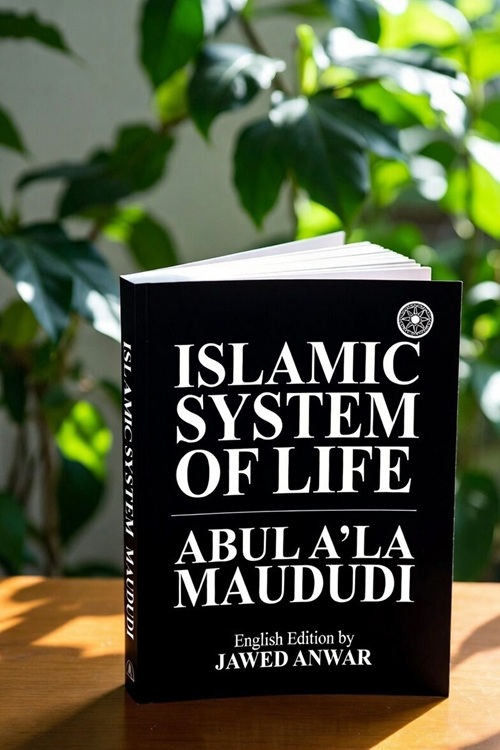
Islamic System of Life - Chapter 3: Islam and Jahiliyyah (Ignorance)
Syed Abul A'la Maududi (1903–1979)
English Edition: Syed Jawed Anwar
[What is the real difference between true guidance and ignorance? Chapter 3 of Islamic System of Life by Maulana Syed Abul A'la Maududi draws a powerful, clear line between Islam and jahiliyyah (pre-Islamic ignorance and all forms of modern life built without divine guidance). Using everyday logic and examples, it shows how every human decision rests on fundamental beliefs about existence, purpose, and authority. Explore why purely human approaches—whether based on senses alone, speculation, or imagination—lead to division, injustice, and chaos, while the prophetic worldview brings unity, justice, and true freedom. This chapter is essential reading for anyone seeking to understand Islam’s complete way of life and why it remains the only path aligned with reality.]
Islam and Jahiliyyah
Human beings cannot interact with anything in the world—people, objects, situations—without first forming some opinion about its nature, its qualities, and their relationship to it. Whether that opinion turns out to be correct or mistaken doesn’t change the fact: we must hold some view before deciding how to act.
This is your daily experience. When you meet someone, you immediately need to know: Who is this person? What is their status? What are their character traits? What kind of relationship do we have? Without at least a working assumption, you cannot decide how to behave toward them. If you lack clear knowledge, you rely on clues and make an educated guess—and your entire approach flows from that judgment.
The same applies to everything you eat, discard, use, protect, respect, fear, or love. Your actions toward these things are based on the opinion you hold about their true nature and your connection to them.
The correctness of your behavior depends on the correctness of your opinion. And the correctness of that opinion depends on whether it is based on real knowledge, sound reasoning, mere guesswork, illusion, or just surface-level sensory observation.
Take fire as an example. A small child sees its bright, flickering glow and—relying purely on sensory impression—concludes: “This is a beautiful, shiny toy.” So the child reaches out to grab it.
Another person looks at the same fire and, through imagination or speculation, decides: “This contains divinity” or “This is a manifestation of the divine.” Based on that belief, they bow down in worship.
A third person studies fire carefully, learns its properties through observation and reason, and concludes: “This is a source of heat that cooks, burns, and warms. My relationship to it is that of a user to a useful tool.” So they employ it practically—cooking food, heating homes—without treating it as a toy or a god.
Among these three attitudes, the child’s and the fire-worshiper’s are forms of jahiliyyah (ignorance). The child’s view is quickly disproven by painful experience. The fire-worshiper’s belief rests on unproven imagination, not evidence. Only the third person’s approach is truly rational, grounded in verifiable knowledge.
The Fundamental Questions of Life
Now broaden the lens from small examples to the big picture.
You find yourself existing in this world with a body full of powers and abilities. Around you stretches a vast, intricate system—earth, sky, countless things—and you possess the capacity to interact with them.
You are surrounded by other human beings, animals, plants, inanimate objects. Your life depends on all of them. Can you possibly adopt any consistent way of living toward these realities without first answering certain basic questions about yourself and your place in the scheme of things?
Who am I? What am I? Am I accountable or free? If accountable, to whom? If under authority, whose? Does my earthly life have any ultimate purpose or outcome? What is it?
What about my powers and faculties? Are they my private property, or a gift from someone else? Will anyone hold me accountable for how I use them? Who sets the rules for their use—me, or someone higher?
What about the things around me—the earth, its resources, other living beings? Am I their absolute owner, or are my rights limited? If limited, who sets the limits?
And what about my fellow human beings? What defines humanity? On what basis do we distinguish between people? What should guide cooperation, conflict, friendship, enmity?
Finally, what about the universe as a whole? What kind of system is this creation, and what is my true position within it?
As we saw earlier, forming some opinion—conscious or unconscious—about these questions is unavoidable. Without it, you cannot take even one step in life. Not everyone reflects philosophically or writes detailed answers. Many never deliberately ponder these matters. Yet every person, through daily living, arrives at a working answer—positive or negative—and their entire behavior flows from it.
This holds true not just for individuals but for entire societies and civilizations. No social system, culture, or way of life can emerge without some resolution to these fundamental questions. Whatever answers are adopted shape ethics, institutions, laws, economics, politics—everything. The entire civilization takes on the character of those answers.
In practice, there is no escape: a person’s or society’s actual behavior always reflects the real answers operating in their minds, even if their spoken claims differ.
The Three Ways People Have Answered These Questions
These core questions belong to the realm of the unseen (ghayb). No answer is written in the sky for everyone to read automatically. No solution is self-evident. That is why humanity has never agreed on one answer. Different people have approached these questions in different ways.
Broadly, three main methods have been used:
- Rely purely on sensory experience—what the eyes, ears, and other senses directly perceive—and build opinions from that alone.
- Combine sensory observation with speculation, imagination, and guesswork.
- Accept the guidance of prophets who claim direct, revealed knowledge of reality.
These are essentially the only three approaches possible. Each produces a distinct worldview, a distinct pattern of behavior, and a distinct type of civilization and ethics.
Pure Jahiliyyah (Ignorance Based on Sense Alone)
When people rely solely on sensory experience, they reach a natural conclusion: The universe is a random, purposeless accident. It just “happened.” It runs on its own. It will end without meaning. No owner or purpose is visible, so either none exists, or if one does, it has no connection to human life.
Human beings are simply a kind of animal that appeared by chance. Whether someone created us or we emerged spontaneously doesn’t matter—it’s irrelevant. What we know is that we exist on this earth, driven by desires our nature urges us to fulfill. We possess powers and tools to satisfy those desires, and the world is spread out like a vast banquet for us to exploit. There is no higher authority to answer to, no source of guidance beyond animal instincts or human trial-and-error.
Therefore, humans are completely autonomous and unaccountable. We make our own rules, decide our own purposes, and determine our own relationships with everything else. Any guidance comes only from observing animals, rocks, or our own history. If we answer to anyone, it is only to ourselves or to whatever human power happens to dominate us.
Life is only this worldly existence. All consequences are limited to this life. Right and wrong, beneficial and harmful, are judged solely by what appears in this world.
This is a complete worldview—one built entirely on sensory observation. Its parts fit together logically, allowing a consistent way of life (whether ultimately correct or not). Now look at the behavior it produces.
On the individual level, a person becomes fully autonomous and unaccountable. They view their body and powers as their private property, to use however they please. Whatever things or people come under their control are treated as possessions. Limits come only from physical laws or social necessities. Inside, there is no moral restraint, no fear of higher accountability, no inner discipline to prevent excess.
Where external checks are absent or can be overcome, the natural outcome is oppression, dishonesty, cruelty, and corruption. Such a person becomes self-centered, materialistic, and opportunistic by instinct.
Life’s purpose narrows to serving personal desires and animal needs. Value is assigned only to things that advance those ends.
In society built on this mindset, the highest collective ideal is usually a “commonwealth”—a shared human enterprise at best. Politics rests on human sovereignty—whether of one person, a family, a class, or the masses. Laws are made and changed according to human desires and perceived utility. Power goes to the strongest, cleverest, most ruthless—those most skilled at manipulation, deceit, and force. Might becomes right.
Culture and society revolve around self-gratification. Moral standards loosen to minimize obstacles to pleasure. Art and literature increasingly reflect sensuality and exhibitionism. Economies swing between feudalism, capitalism, and worker uprisings—none ever achieving true justice, because the underlying view treats the world as a free-for-all banquet.
Education and upbringing instill this same worldview: the universe is purposeless, humans are autonomous, life is only this world. Generations are trained to fit into and perpetuate such a society.
This is pure jahiliyyah—the attitude of ignorance. It is like the child who sees fire as a toy: the mistake is eventually exposed by painful experience. But in this case, the “fire” burns slowly over centuries, so many never recognize the error—even as individuals suffer dishonesty, rulers oppress, judges pervert justice, the rich exploit, and nations devour one another.
The bitter fruits—personal corruption, social injustice, endless wars, imperialism, destruction—are the clearest proof that this worldview does not match reality.
Other Forms of Jahiliyyah
The second approach mixes observation with speculation and imagination, producing three main variants:
- Polytheism (Shirk)
The universe is not ownerless, but it has many owners—multiple gods or lords, each controlling different forces. Human success or failure depends on winning the favor of these many powers.
This leads to superstition, rituals, offerings, and endless ceremonies to appease imagined deities. Life becomes entangled in fantasy. Clever individuals exploit this—kings claim divine descent, priests act as intermediaries, magicians sell charms—creating hereditary classes that dominate and oppress. Ultimately, polytheistic societies follow the same ethical, political, and economic patterns as pure sense-based jahiliyyah. The only difference is added superstition.
- Monasticism / Asceticism (Rahbaniyyah)
The world and physical existence are a prison of punishment. The soul is trapped in the body. Desires and needs are chains. Salvation lies in renouncing the world, suppressing desires, mortifying the flesh, and withdrawing from society.
This produces withdrawal, negativity, and isolation. Good people retreat to solitude, leaving the world to the wicked. Civilization suffers from loss of positive energy. Humanity becomes passive and tame before oppressors.
In practice, pure asceticism often collapses under human nature, leading to hypocrisy—secret indulgence hidden behind outward renunciation.
- Pantheism / Monism (Everything is One)
All things, including humans, are unreal or illusory. Only one ultimate existence is real, manifesting through everything. The self is part of that oneness.
This leads to confusion about personal identity and purpose. Effort seems pointless. The person becomes passive or, paradoxically, indulgent (“since everything is one, my desires are also divine”).
The practical outcome often resembles either ascetic withdrawal or unrestrained self-gratification.
All three are forms of jahiliyyah because none rests on verified knowledge—only on speculation. Their repeated failure in practice proves they do not match reality.
The Islamic Approach
The third method is to accept the guidance of prophets who claim direct knowledge from the Creator. This is like being lost in an unfamiliar place: you seek someone trustworthy who knows the area, verify their credibility through evidence, then follow their directions. If experience confirms their guidance is reliable, you trust it fully.
The prophets claim exactly this: direct knowledge of reality. Their lives demonstrate unmatched truthfulness, integrity, selflessness, and soundness of mind. This gives strong initial grounds for trust.
Then you test their teachings against observation and experience. Do their explanations fit the facts of the universe? Does living according to their guidance produce good outcomes?
The prophets teach:
This entire creation is not a random accident. It is a perfectly organized kingdom with one supreme Creator and Ruler—Allah alone. All power rests in His hands. No other authority exists.
Every force, every particle, obeys His laws without exception. No part of creation is independent or unaccountable. Humans are born subjects—servants ('abd) of Allah. This is not optional; it is our inherent reality.
Therefore, we do not make our own rules or decide our own purpose. Our bodies, powers, and all resources belong to Allah. We use them only according to His will.
The world and everything in it is His property. Our relationships with people and things must follow His law.
The prophets deliver this law directly from Allah. Trust them as His authentic representatives.
They further explain: The apparent freedom you feel—the ability to act as you wish without immediate consequences—is part of a deliberate test. Allah has veiled Himself and loosened the reins to see how you will use your reason, choice, and freedom.
This worldly life is a testing ground (dar al-imtihan), not a place of final reward or punishment (dar al-jaza). Here, outcomes are not always direct justice. Wealth, power, children, hardships—these are means of trial, to reveal your true character.
True and full accountability comes in the life after death, where every deed is judged perfectly. Success depends on two things:
- Recognizing Allah’s sovereignty and the truth of prophetic guidance through reason and evidence.
- Willingly submitting to that guidance, even when free to rebel.
The Islamic Worldview in Practice
This worldview is complete and internally consistent. Every part supports the others. It explains all observed facts without contradiction. No experience has ever disproven it. It is the most probable explanation of the universe’s order: a purposeful system under one wise, all-knowing Ruler.
It is also fully practical. It provides a comprehensive framework for every aspect of life—ethics, law, economics, politics, international relations—without leaving any area to human whim.
On the individual level, it creates profound responsibility and discipline. Believers see themselves as trustees of Allah’s gifts. Every action is accountable. No hidden thought escapes His knowledge. This inner restraint prevents excess even when no one is watching.
Such people become trustworthy, just, and purposeful. Their efforts serve higher moral goals, not selfish desires.
On the social level, it eliminates all false hierarchies. All humans are equal servants of Allah. No one has innate superiority based on birth, wealth, race, or power. Distinctions rest only on moral excellence and God-consciousness.
It destroys tribalism, nationalism, racism—everything that divides humanity. The only meaningful divide is between those who accept Allah’s sovereignty and those who do not—and even that divide can be crossed through sincere change.
Society becomes a community bound by divine law. The state exists to implement Allah’s guidance, not human invention. Rulers are servants, not lords. Laws aim at universal justice, not favoritism.
The spirit of taqwa (God-consciousness) permeates everything. Taxes are paid as trusts to Allah. Officials act as if standing before Him. Education raises generations with this worldview.
History has seen this system implemented. It produced individuals of unmatched integrity and societies of remarkable justice and balance. When practiced sincerely, it remains the most effective path to human flourishing.
If any other worldview consistently produced better results, we could question this one. But experience shows: only when individuals and societies align with this prophetic teaching do true peace, justice, and security emerge.
This is Islam—not just a religion, but a complete system of life rooted in reality.
LEAVE A REPLY
Recent posts
-
Islamic System of Life - Chapter 9: Bearing Witness to the Truth
09 February 2026 -
Islamic System of Life - Chapter 8: Jihad in the Path of God
08 February 2026 -
Islamic System of Life - Chapter 7: Construction and Destruction
08 February 2026 -
Islamic System of Life - Chapter 6: The Moral Foundations of the Islamic Movement
08 February 2026 -
Islamic System of Life - Chapter 5: Islam’s Ethical Perspective
04 February 2026 -
Islamic System of Life - Chapter 4: The True Deen (Way of Life)
26 January 2026
Comments
Zia
Very good analysis 👍
Ehsan Syed
I was looking for something like this , a comparison between jahiliya and Islam , Imams today do not want to do the comparison and tell People why islam is better and what Allah and his Prophet changed for better of humanity and how it was pre Islamic era and still some forms of jahiliyah that people think it a good act